Quick answer
DEXA and MRI can both add body-composition detail, but they do not measure the body in the same way or answer the same question. A whole-body DEXA scan estimates fat mass, lean soft tissue, and bone mineral content, often with broad regional results for the arms, legs, and trunk. MRI creates detailed images with strong soft-tissue contrast, which can be used to examine specific tissues and anatomical compartments.
For someone who wants a practical whole-body baseline and a repeatable check-in during a fat-loss, muscle-gain, or body-recomposition phase, DEXA is often the more direct body-composition tool. An MRI may be used when a clinician needs detailed information for a separate medical question. One result is not a conversion table for the other, so the best first step is to decide what you are actually trying to learn.
If you are building that first repeatable baseline in Irvine or Orange County, start with DEXA Scan in Irvine & Orange County.
What a DEXA body-composition scan estimates
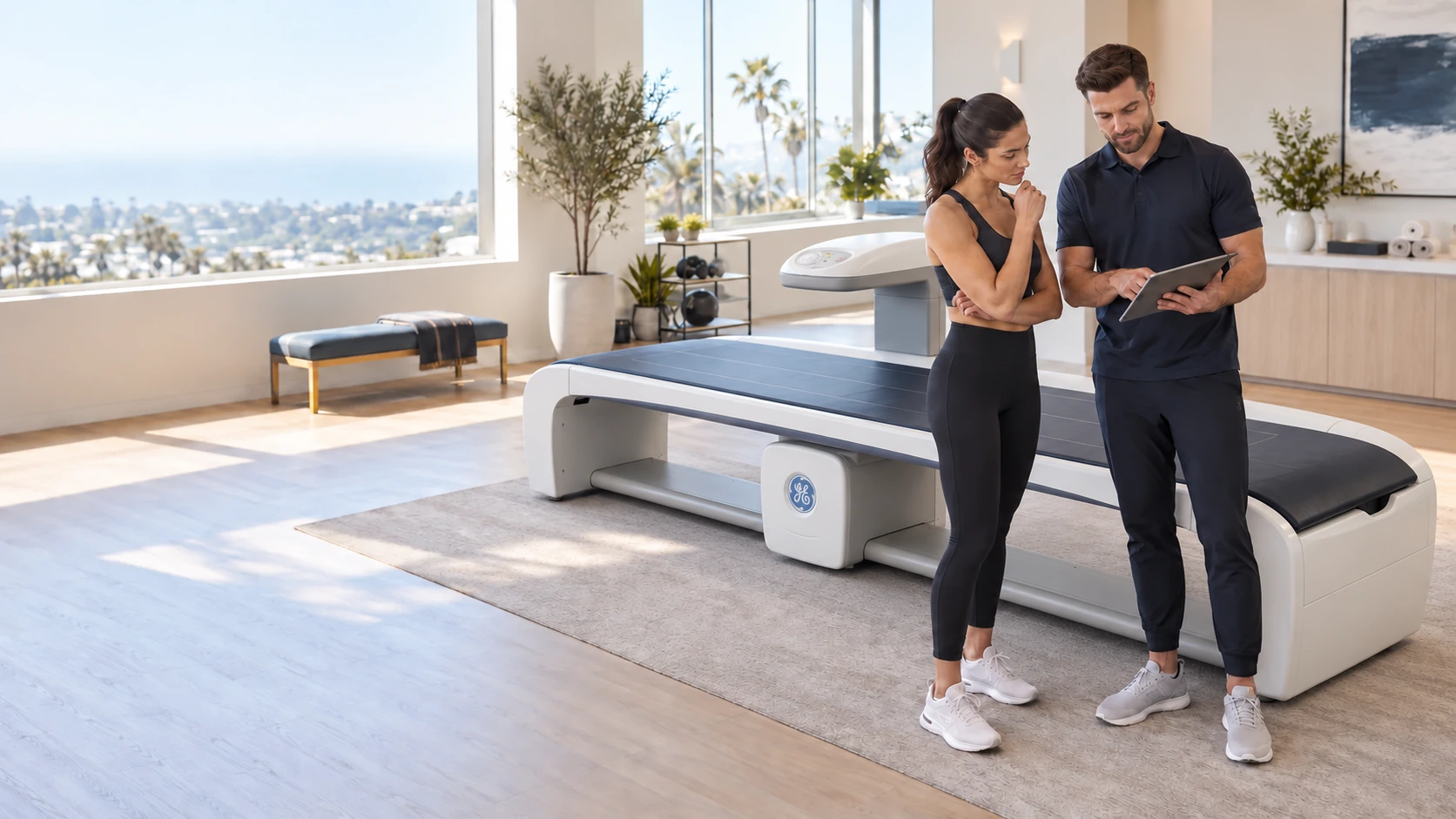
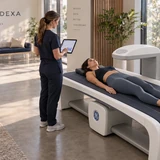
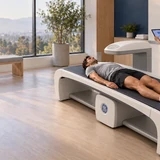
DEXA uses two X-ray energy levels and software to estimate three broad components of total body mass:
- Fat mass: the estimated mass attributed to fat.
- Lean soft tissue: non-fat, non-bone soft tissue. It includes muscle, but also water and other tissue.
- Bone mineral content: the mineral component reported separately from soft tissue.
The International Society for Clinical Densitometry lists total mass, total lean mass, total fat mass, percent fat mass, and bone mineral content among the values that should appear on adult total-body reports. Depending on the scanner and software, a report can also add regional estimates and optional measures such as visceral adipose tissue or ratios.
That makes DEXA useful when your question is practical and whole-body: Is estimated fat mass moving in the direction you intended? Is lean soft tissue relatively stable during a cut? Are total and regional trends coherent with your scale weight, training, and measurements?
For a guide to the labels on a report, see How to Read Your DEXA Scan Results.
What MRI can add
MRI uses magnetic fields and radio waves rather than ionizing radiation. Its strength is detailed soft-tissue imaging: MRI can distinguish and quantify anatomical structures such as skeletal muscle and fat depots, and can provide more spatial detail about a specific area than a whole-body composition report.
That difference matters. An MRI-based result may describe an anatomical compartment or tissue volume. A DEXA result estimates components such as fat mass and lean soft tissue from X-ray attenuation. The NIH/PMC review of MRI body-composition assessment explains why MRI is well suited to detailed adipose-tissue and muscle characterization, while also reflecting a more specialized imaging workflow.
An MRI should not be treated as a consumer body-composition upgrade by default. If a clinician has ordered one, its protocol and interpretation should follow the clinical reason for that exam. A fitness-oriented body-composition scan does not diagnose an injury, evaluate an organ, or replace medical imaging.
Why DEXA and MRI results do not match number for number
The main reason is that the two methods define their outputs differently.
- They describe different compartments. DEXA fat mass is a body-composition estimate, while MRI can quantify anatomical adipose-tissue compartments. Those are related, but not identical, concepts.
- Lean soft tissue is broader than muscle. A DEXA lean-soft-tissue number includes water and other non-fat, non-bone tissue. MRI can provide more anatomical detail about muscle, but that does not make its value directly interchangeable with DEXA lean mass.
- Software and protocol matter. The region being analyzed, scanner model, positioning, and analysis software can affect what a report includes and how values are calculated.
- The useful comparison is usually within one method. For an individual progress trend, repeat the same method under similar conditions instead of trying to convert an MRI value into a DEXA target or the reverse.
The NIH/PMC review of DEXA body composition notes that DEXA fat mass and MRI or CT adipose-tissue measures represent different compartment models. It also explains why DEXA lean mass can be higher than MRI or CT muscle measures: DEXA lean mass includes water and other non-fat components.
Which question should guide your choice?
Choose the question before choosing the test.
- "I want a whole-body baseline for a focused fitness phase." A DEXA scan can give you a practical set of fat mass, lean-soft-tissue, bone-mineral, and broad regional estimates to revisit after a meaningful training or nutrition block.
- "I want to compare body composition over time." Use the same DEXA location and scanner when possible, and keep preparation similar. That gives the trend the best chance of being interpretable.
- "My clinician needs a detailed look at a specific tissue or body area." That is a medical-imaging question. Follow the clinician's recommendation for the appropriate exam rather than using a DEXA report as a substitute.
- "I am concerned about radiation, pregnancy, or a medical condition." Tell the ordering provider or imaging facility before any scan. The ISCD lists pregnancy as a contraindication to DXA body composition, and the right imaging decision depends on your individual circumstances.
For a DEXA comparison to a non-imaging body-composition method, read DEXA Scan vs InBody. For a careful look at the low-dose X-ray component of DEXA, see How Much Radiation Is in a DEXA Body Composition Scan?.
How to make a DEXA trend more useful
A detailed first scan is most useful when the follow-up is comparable. The goal is not to make every day identical; it is to avoid turning a one-off change in hydration, food timing, training, or positioning into the whole story.
- Use the same scanner and location when practical.
- Match the time of day, clothing, meals, hydration, and recent training as closely as you reasonably can.
- Compare after a meaningful block of consistent work, not after a few unusually strict days.
- Read estimated fat mass and lean soft tissue beside scale weight, waist measurements, training performance, and recovery.
The ISCD's body-composition positions likewise emphasize consistent preparation, activity, clothing, time of day, and positioning for precise measures. For a practical appointment checklist, use How to Prepare for a DEXA Scan.
Quick FAQ
Is MRI more accurate than DEXA for body composition?
Neither method is universally "more accurate" without naming the compartment and purpose. MRI can provide detailed anatomical information about muscle and fat depots. DEXA provides a practical whole-body three-compartment estimate. Because their outputs are defined differently, do not treat one as a correction factor for the other.
Can an MRI replace a DEXA scan?
Not automatically. An MRI may be the right study for a clinician's specific diagnostic or anatomical question. A DEXA scan may be the more useful repeatable body-composition baseline for a fitness goal. The appropriate choice depends on the question, not on a universal ranking.
Does MRI use radiation?
MRI does not use ionizing radiation. DEXA does use low-dose X-rays. If radiation exposure, pregnancy, implanted devices, symptoms, or another medical factor is relevant to you, discuss it with the clinician or imaging provider before scheduling any exam.
Can a DEXA scan show a muscle tear or injury?
No. DEXA estimates body-composition compartments; it does not diagnose injuries or show the cause of pain, weakness, or loss of function. Those concerns need appropriate medical evaluation.
Should I compare my DEXA scan with an MRI report?
You can use both reports as context, but avoid calculating a direct conversion between their fat or lean values. For a progress trend, compare repeated results from the same method and keep the testing setup consistent.
Build a baseline you can use in Irvine
If your goal is to track a focused body-composition phase rather than answer a medical imaging question, a DEXA baseline can make the next milestone clearer. Compare DEXA Scan Cost in Orange County, then join the Founding Member List before booking opens to lock in $49 standard CLUB DEXA body composition scans for life, subject to additional terms. Expected regular pricing after launch starts at $89 per standard scan. No payment is due today, and email confirmation is required before Founding Member pricing is treated as locked.
Sources and fine print
- International Society for Clinical Densitometry: 2023 Official Adult Positions
- NIH/PMC: Body composition with dual-energy X-ray absorptiometry
- NIH/PMC: MRI in the assessment of adipose tissues and muscle composition
CLUB DEXA provides body-composition scans for fitness and wellness tracking. It does not diagnose injuries or medical conditions, prescribe treatment, provide medical advice, or decide which medical imaging exam is appropriate. DEXA estimates can vary by scanner, software, protocol, and individual testing conditions. Discuss symptoms, pregnancy, implanted devices, radiation concerns, and individualized health questions with an appropriate qualified healthcare professional.
Related articles
DEXA Scans for Healthy Aging: What to Track
Learn how older adults can use a DEXA body-composition baseline alongside strength, movement, and clinical care.
DEXA Scan and PCOS: What a Body-Composition Baseline Can Tell You
Learn what a DEXA body-composition baseline can track with PCOS, what it cannot diagnose, and how to use repeat scans without reducing your health to one number.

DEXA Scans for Endurance Athletes: What to Track
Learn how runners, cyclists, and triathletes can use DEXA body-composition scans as repeatable checkpoints without confusing a scan with a performance or health diagnosis.

Join as a Founding Member
Lock in $49 DEXA scans for life. Join the Founding Member List before booking opens in Irvine. Your standard body composition scan price will never increase, subject to additional terms. Expected regular pricing after launch starts at $89 per scan.
- $49 scans for life
- Priority launch booking
- No cost to join
No payment today. No spam. Your Founding Member price will never increase. Founding pricing applies to standard CLUB DEXA body composition scans for the registered email/account holder. Founding Member pricing includes up to 6 standard scans per calendar year. Additional scans are subject to regular pricing. Non-transferable. Excludes add-ons, bundles, third-party services, and special clinical services. Subject to appointment availability. Expected regular pricing may change before or after launch. Email verification is required before Founding Member pricing is treated as locked.