Quick answer
A whole-body DEXA body composition scan uses ionizing radiation, but the dose from a modern system is very small. Peer-reviewed reviews commonly place a modern whole-body scan at about 4 to 5 microsieverts, while a broader review describes a single scan as below 10 microsieverts. That is roughly the same order of magnitude as the natural background radiation a person receives over about one day.
The dose is not identical for every scan. It can vary with the scanner model, scan mode, body size, imaging speed, and protocol. The practical takeaway is low dose, not zero dose. If you are pregnant, may be pregnant, or have a question about whether a scan is appropriate for you, tell the provider before the appointment and follow its safety policy.
The short version
- Modern whole-body DEXA: often reported around 4 to 5 microsieverts
- Broader published range for a single whole-body scan: generally below 10 microsieverts in a major review
- Everyday context: approximately the same order as one day of natural background radiation
- Important distinction: low exposure does not mean no exposure
- Before scanning: disclose a known or possible pregnancy and ask the provider about any individual concern
If you are still deciding what type of appointment you need, first compare body composition DEXA with bone density DEXA.
What does a microsievert mean?
Radiation exposure is often discussed using the sievert, a unit that helps describe the biological effect of ionizing radiation. A microsievert, written as µSv, is one millionth of a sievert.
The unit sounds technical, but the comparison is straightforward. A 2020 review of whole-body DEXA reported about 4 to 5 µSv for newer densitometers and cited average natural background exposure of about 6.7 µSv per day. A separate review described a single whole-body scan as less than 10 µSv and similarly compared it with about one day of natural background exposure at sea level.
Natural background exposure is not identical everywhere, and scanner protocols differ. Use the comparison as scale, not as a promise that every appointment produces one exact dose.
Why the exact DEXA dose varies
There is no universal dose number that applies to every body composition scan. Published reviews identify several variables that can change the exposure:
- Scanner manufacturer and model
- Scan mode and image resolution
- Tube settings and scan speed
- The length of the area being scanned
- Body size and tissue thickness
- Whether an image needs to be repeated
This is why a responsible provider should avoid presenting one number as a guarantee for every person. If you want the most specific estimate, ask which scanner and whole-body protocol the facility uses.
How a DEXA body composition scan uses X-rays
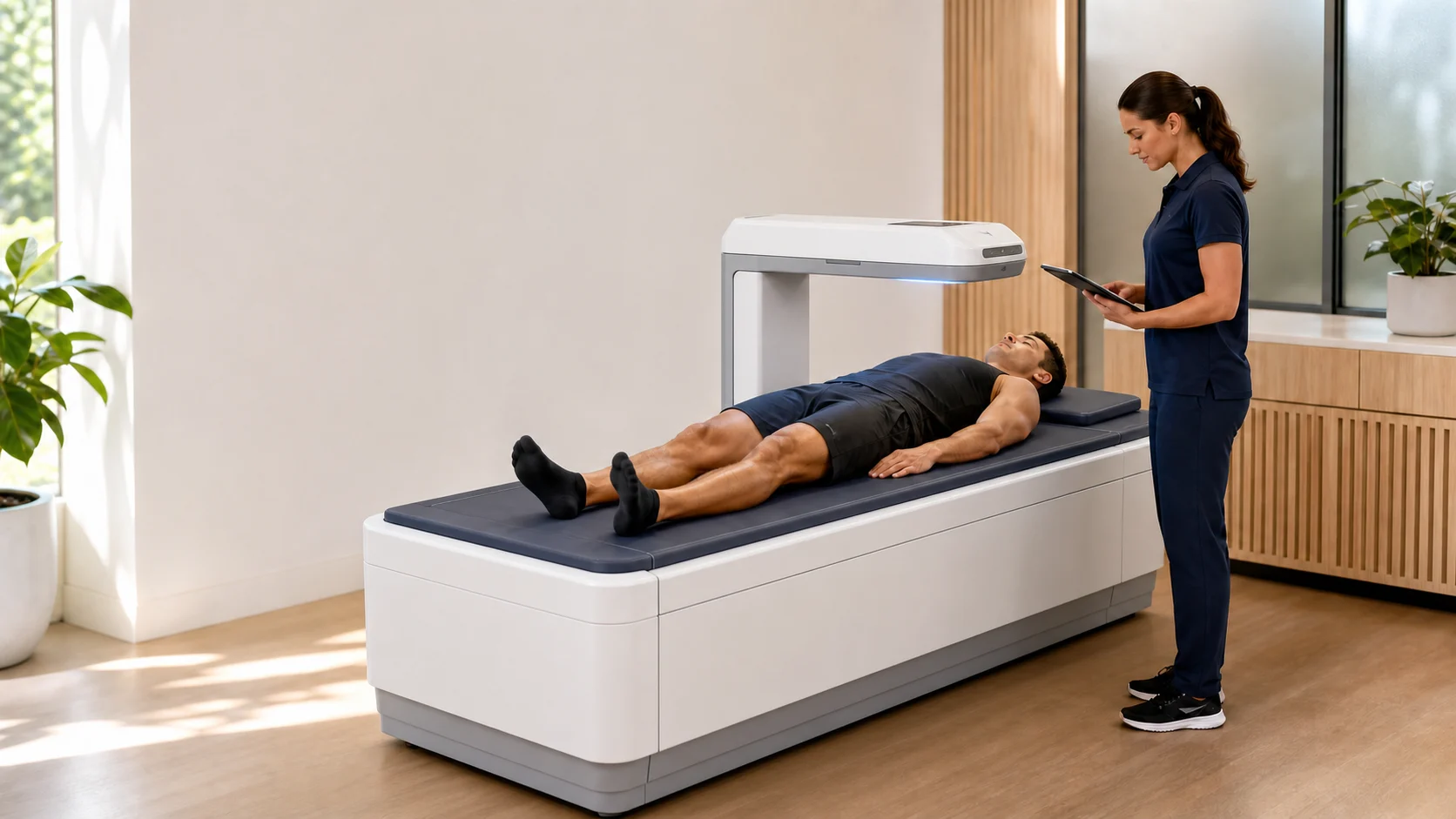
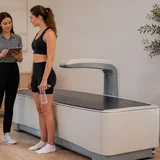
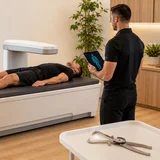
DEXA stands for dual-energy X-ray absorptiometry. The scanner sends two low-energy X-ray beams through the body. Because bone, fat, and lean soft tissue attenuate those beams differently, the system can estimate bone mineral content, fat mass, and lean mass.
The detector moves above the scanning table while the client lies still. The exam does not leave radioactive material in the body. RadiologyInfo, the patient-information site supported by the American College of Radiology and Radiological Society of North America, notes that no radiation remains in the body after an X-ray examination.
For a plain-English overview of the measurements produced, read what a DEXA body composition scan measures.
Is whole-body DEXA the same as a bone density exam?
The same core technology can be used for different exams, but a whole-body body composition scan is not the same protocol as a clinical hip-and-spine bone density exam.
A body composition scan covers the whole body to estimate fat, lean soft tissue, and bone mineral content by region. A diagnostic bone density exam usually focuses on specific skeletal sites and is interpreted in a medical context. Scan area, settings, report, purpose, and dose can therefore differ.
That distinction matters when reading radiation comparisons online. A dose statement about one DXA protocol should not automatically be treated as the exact dose for every other protocol.
What to do before your appointment
Most fitness clients do not need to calculate a personal radiation number before every scan. A short safety checklist is more useful:
- Tell the provider if you are pregnant or may be pregnant.
- Ask which whole-body scanner and protocol the facility uses if dose is a concern.
- Share any recent imaging, contrast study, or provider instruction that may affect scheduling.
- Follow the facility's preparation and eligibility rules.
- Avoid booking an immediate repeat only because preparation was inconsistent; ask the operator what should happen next.
The ACR/RSNA patient guidance for DXA tells patients to disclose a possible pregnancy and recent contrast or nuclear-medicine imaging before the exam. A body composition facility may have its own screening questions and waiting periods, so contact it when you are unsure rather than guessing.
For the broader appointment checklist, see how to prepare for a DEXA scan.
Does the low dose mean you should scan constantly?
No. Radiation is only one part of deciding when a follow-up scan is useful. You also need enough time for a training, nutrition, or weight-change plan to produce a meaningful body composition signal.
A scan repeated too soon can create more noise than insight, even when the radiation exposure is low. Hydration, food, recent training, glycogen, positioning, and normal measurement variation can all complicate a short-interval comparison.
Plan repeat scans around the decision you need to make. A baseline followed by a well-matched scan after a meaningful training or nutrition block is usually more informative than frequent testing without time for change. The guide to how often to get a DEXA scan explains that planning question in more detail.
How to think about risk without overreacting
Two ideas can be true at the same time:
- Whole-body DEXA uses ionizing radiation.
- The dose from a modern body composition scan is very low compared with many familiar sources of medical imaging exposure.
Calling the exposure "zero" would be inaccurate. Treating it as comparable to a high-dose imaging study would also be misleading. The better approach is to use a justified scan, follow provider screening, avoid unnecessary repeats, and interpret the result as fitness and wellness data rather than a medical diagnosis.
Quick FAQ
Does a DEXA body composition scan have radiation?
Yes. DEXA uses low-dose ionizing X-rays. Modern whole-body body composition scans are commonly reported at only a few microsieverts, but the exact dose depends on the equipment and protocol.
How does that compare with everyday background radiation?
Published reviews place a modern whole-body scan in roughly the same order of magnitude as about one day of natural background exposure. Background levels and scan doses both vary, so this is a context comparison rather than an exact conversion.
Does radiation stay in your body after a DEXA scan?
No. A DEXA scan uses an external X-ray beam and does not leave radioactive material in your body.
Can I get a DEXA scan if I am pregnant?
Tell the provider if you are pregnant or may be pregnant before the appointment. The provider should apply its safety and eligibility policy and direct you to an appropriate clinician when needed. Do not rely on a general article for an individual pregnancy decision.
Is a body composition DEXA the same as a diagnostic bone density scan?
No. They use the same underlying technology but differ in purpose, scan area, protocol, report, and clinical interpretation.
Should radiation determine how often I rescan?
It is one consideration, but usefulness and measurement timing matter too. Follow the provider's policy and allow enough time for the body composition trend you want to evaluate.
Build a useful baseline in Irvine
If you want a detailed fat mass, lean mass, and regional body composition baseline in Irvine or Orange County, use the scan to answer a specific question and plan the follow-up around a meaningful goal period.
Read the local guide to DEXA scans in Irvine, then join the Founding Member List before booking opens to lock in $49 standard CLUB DEXA body composition scans for life, subject to additional terms. Expected regular pricing after launch starts at $89 per standard scan. No payment is due today, and email confirmation is required to lock the offer.
Sources and fine print
- PubMed: Body composition by DXA
- PubMed: Body composition with dual-energy X-ray absorptiometry, from basics to new tools
- RadiologyInfo: Bone Density Scan (DEXA or DXA)
CLUB DEXA provides body composition scans for fitness and wellness tracking. It does not diagnose medical conditions, provide individualized radiation-risk assessment, or replace medical advice. Scanner dose and eligibility depend on equipment, protocol, individual circumstances, and provider policy. Discuss pregnancy, recent medical imaging, health conditions, and personal safety concerns with the scan provider and an appropriate qualified healthcare professional.
Related articles
Should You Drink Water Before a DEXA Scan?
Learn how water intake can affect a DEXA body-composition result and how to keep repeat scans more comparable.
DEXA Scan vs Waist Measurement: What Each Can Tell You
Compare a DEXA body-composition scan with a waist measurement, including what each tracks, why the numbers are not interchangeable, and how to use both in a repeatable progress routine.
DEXA Scan vs Skinfold Calipers: Which Is Better for Body Fat Tracking?
Compare DEXA scans and skinfold calipers for body-fat tracking, including what each method measures, why the results differ, and how to choose a repeatable baseline.


Join as a Founding Member
Lock in $49 DEXA scans for life. Join the Founding Member List before booking opens in Irvine. Your standard body composition scan price will never increase, subject to additional terms. Expected regular pricing after launch starts at $89 per scan.
- $49 scans for life
- Priority launch booking
- No cost to join
No payment today. No spam. Your Founding Member price will never increase. Founding pricing applies to standard CLUB DEXA body composition scans for the registered email/account holder. Founding Member pricing includes up to 6 standard scans per calendar year. Additional scans are subject to regular pricing. Non-transferable. Excludes add-ons, bundles, third-party services, and special clinical services. Subject to appointment availability. Expected regular pricing may change before or after launch. Email verification is required before Founding Member pricing is treated as locked.