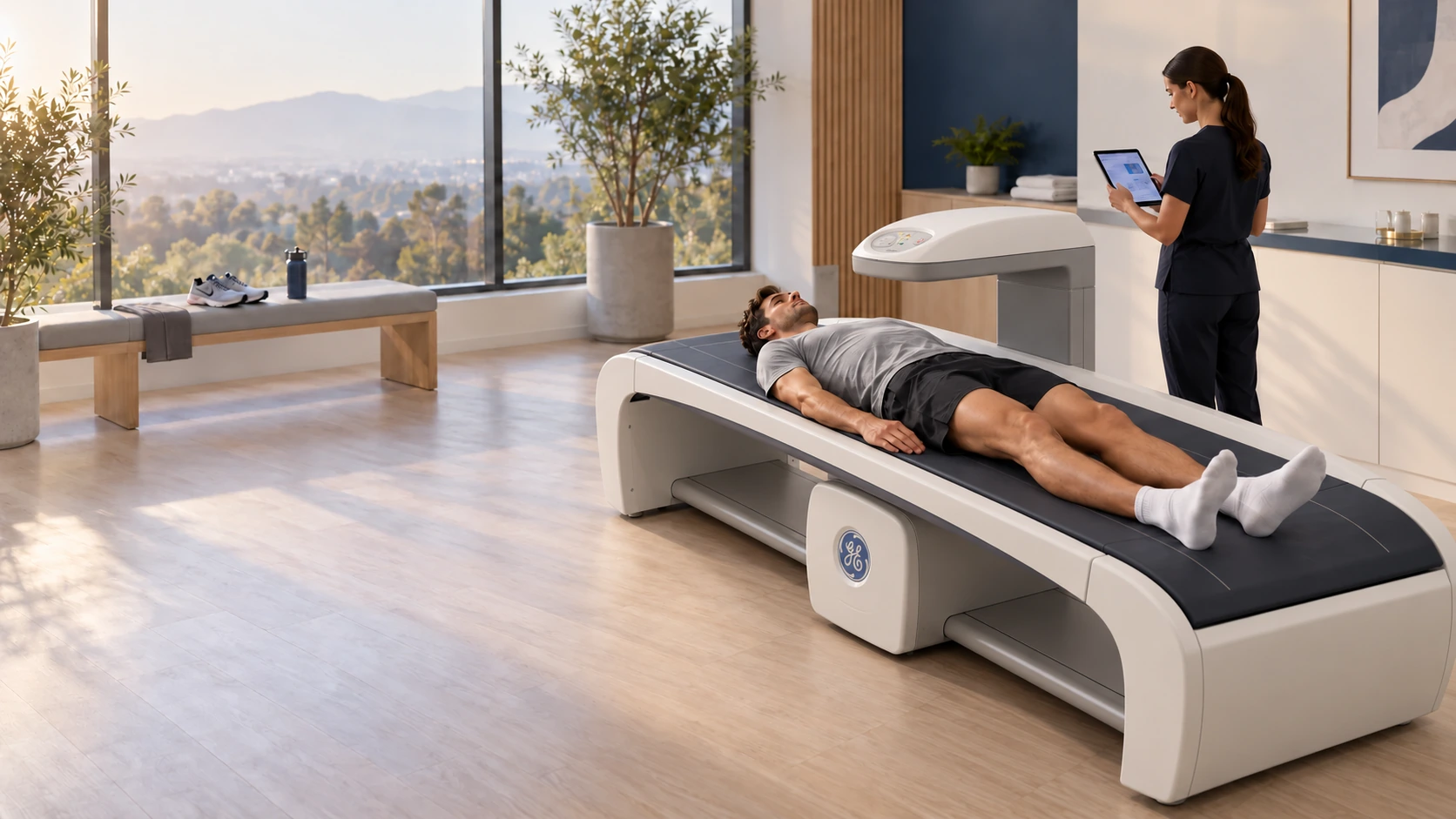
Quick answer
For runners, cyclists, and triathletes, a DEXA scan is most useful as a repeatable body-composition checkpoint—not as a score for fitness, fueling, or race readiness. It can estimate fat mass, lean soft tissue, bone mineral content, and broad regional results. That can add context when your training volume, body weight, or goal phase is changing.
The useful question is usually small and practical: after a meaningful training and nutrition block, did estimated fat mass and lean soft tissue move in a way that fits the rest of the picture? A scan cannot measure VO2 max, lactate threshold, running economy, injury risk, or whether you are adequately fueled. It should sit beside performance, recovery, training load, and qualified coaching or clinical guidance—not replace them.
If you want a consistent body-composition baseline in Irvine or Orange County, start with DEXA Scan in Irvine & Orange County.
What an endurance-athlete DEXA scan can add
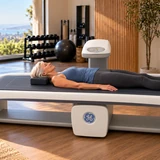
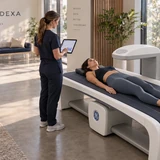
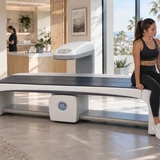
A whole-body DEXA scan estimates several broad components of measured mass. The International Society for Clinical Densitometry's 2023 Official Positions list total mass, total lean mass, total fat mass, percent fat mass, bone mineral content, and bone mineral density among the values that should appear on an adult total-body report.
For an endurance athlete, that can make the scan a useful milestone tool when the result will inform a real conversation or decision. For example:
- Establish a baseline before a deliberate training, nutrition, or body-composition phase.
- Put a body-weight change beside estimated fat mass and lean soft tissue rather than assuming every pound gained or lost is the same kind of tissue.
- Add broad regional context to your strength work, training log, and performance data.
- Revisit the same questions after a meaningful, consistent block instead of reacting to day-to-day scale noise.
Lean soft tissue is not a direct muscle-performance score. It includes muscle, but also water and other non-fat, non-bone tissue. Treat the estimate as one part of a trend, not proof that a specific workout, supplement, or meal plan created a performance outcome.
For a plain-English guide to the rest of a report, see How to Read Your DEXA Scan Results.
Make repeat scans comparable before making them frequent
Endurance training naturally creates changing conditions: hard sessions, long rides or runs, heat, travel, different meal timing, and shifting hydration routines. That does not make DEXA useless. It means the value of a follow-up depends on making the setup reasonably comparable.
An applied-sport review of body-composition methods notes that reliable DEXA data require control of factors including food intake, prior exercise, and hydration. The same review emphasizes that no single method is a universal personal truth for every athletic context. Read the athlete-methods review.
For a cleaner comparison, try to keep these details similar when practical:
- Use the same scanner and location.
- Scan at roughly the same time of day.
- Follow a similar meal, hydration, clothing, and bathroom routine.
- Avoid treating a hard workout, unusually long event, or stressful travel day as a normal baseline.
- Compare after enough consistent training time for the answer to affect your next decision.
That does not require perfection. It reduces the chance that a short-term condition becomes the whole story. How to Prepare for a DEXA Scan has a practical appointment checklist.
Choose the question before the scan
A DEXA report works best when you know what you will do with it. Before booking, write down the specific question you hope the follow-up will answer.
During a base or strength block
You may want a baseline that helps you discuss whether estimated lean soft tissue, fat mass, and body weight are moving coherently with your strength work, mileage, and recovery. A DEXA report can add context; it does not prove that training is producing a particular physiological adaptation.
During a body-composition goal phase
If you are intentionally trying to lose fat or change body weight, the scan can help separate estimated fat-mass and lean-soft-tissue trends from scale weight. For a related guide, see DEXA Scan for Fat Loss Tracking.
Around a race or event season
Do not use a body-composition number as a last-minute test of whether you are ready to compete. An athlete may find a planned baseline or post-block checkpoint useful, but racing performance still depends on training, pacing, recovery, fueling, course conditions, and many other factors that a DEXA scan does not measure.
What a DEXA scan cannot diagnose
Body-composition data deserve context, especially in endurance sport. A DEXA scan cannot diagnose low energy availability, Relative Energy Deficiency in Sport (REDs), an eating disorder, an injury, a hormone condition, or the cause of fatigue.
The 2023 International Olympic Committee consensus statement on REDs describes a clinical assessment process that brings together multiple risk indicators, history, testing, and expert medical interpretation. A single body-composition report is not that process.
If you have persistent fatigue, recurrent bone stress injuries, unexplained performance changes, menstrual changes, restrictive eating, a concern about fueling, or another health concern, use the appropriate clinician, sports dietitian, and care team. CLUB DEXA does not diagnose, prescribe, clear athletes for sport, or manage medical treatment.
Pair the scan with the signals that matter in training
The strongest use of a DEXA result is usually as one layer of a broader review. Consider it alongside:
- Your training log and recent volume or intensity.
- Race, workout, or power/pace trends interpreted in context.
- Strength work, mobility, and injury history.
- Sleep, recovery, mood, appetite, and day-to-day energy.
- Body weight, fit of clothing, and other low-cost trend data.
- Guidance from a qualified coach, dietitian, or clinician when appropriate.
This keeps the scan in the right role: a standardized checkpoint that may make a later conversation more informed, not a verdict about the athlete or the plan.
Quick FAQ
Can a DEXA scan tell me whether I have enough muscle to run, ride, or race well?
No. A DEXA report can estimate lean soft tissue and broad regional values, but it does not measure endurance performance, sport-specific strength, movement quality, or readiness to race.
Can a DEXA scan prove that I am adequately fueled?
No. A body-composition scan cannot diagnose low energy availability or confirm an individualized fueling plan. If fueling or health is a concern, discuss it with an appropriate clinician or sports dietitian.
Should I get a DEXA scan right before a race?
Only if you and your support team have a clear use for the result. A new body-composition number is rarely a useful last-minute readiness test. A baseline or post-block scan is often easier to interpret when it fits a planned decision point.
Why might two scans not match exactly?
DEXA estimates can shift with scanner hardware and software, positioning, clothing, time of day, food, hydration, and recent activity. Repeating the same setup makes a trend more useful. See DEXA Scan Accuracy: What Can Affect Results? for the practical details.
Is DEXA better than every other body-composition method for athletes?
No single method is best for every question. DEXA is particularly useful when you want whole-body and broad regional estimates in a consistent, repeatable appointment. Other methods can be more practical for frequent field check-ins. The important rule is to understand the method's limits and avoid converting results between tools as if they were interchangeable.
Build a useful baseline in Irvine
If you want a body-composition checkpoint that fits a real training decision, a DEXA baseline can put estimated fat mass and lean soft tissue beside the rest of your endurance training data. Compare DEXA Scan Cost in Orange County, then join the Founding Member List before booking opens to lock in $49 standard CLUB DEXA body composition scans for life, subject to additional terms. Expected regular pricing after launch starts at $89 per standard scan. No payment is due today, and email confirmation is required before Founding Member pricing is treated as locked.
Sources and fine print
- International Society for Clinical Densitometry: 2023 Official Adult Positions
- NIH/PMC: Common body-composition methods in applied sports practice
- British Journal of Sports Medicine: 2023 IOC consensus statement on REDs
CLUB DEXA provides body-composition scans for fitness and wellness tracking. It does not diagnose medical conditions, assess athlete readiness, prescribe training or nutrition, provide medical advice, or clear athletes for sport. DEXA estimates can vary by scanner, software, protocol, and individual testing conditions. Discuss symptoms, pregnancy, medications, injuries, disordered-eating concerns, abnormal test results, or individualized health questions with an appropriate qualified healthcare professional.
Related articles
DEXA Scans for Healthy Aging: What to Track
Learn how older adults can use a DEXA body-composition baseline alongside strength, movement, and clinical care.
DEXA Scan and PCOS: What a Body-Composition Baseline Can Tell You
Learn what a DEXA body-composition baseline can track with PCOS, what it cannot diagnose, and how to use repeat scans without reducing your health to one number.
DEXA Scan vs Blood Work: What Each Can and Cannot Tell You
Compare a DEXA body-composition scan with blood work: what each test measures, why the results are not interchangeable, and how to use each for the right question.

Join as a Founding Member
Lock in $49 DEXA scans for life. Join the Founding Member List before booking opens in Irvine. Your standard body composition scan price will never increase, subject to additional terms. Expected regular pricing after launch starts at $89 per scan.
- $49 scans for life
- Priority launch booking
- No cost to join
No payment today. No spam. Your Founding Member price will never increase. Founding pricing applies to standard CLUB DEXA body composition scans for the registered email/account holder. Founding Member pricing includes up to 6 standard scans per calendar year. Additional scans are subject to regular pricing. Non-transferable. Excludes add-ons, bundles, third-party services, and special clinical services. Subject to appointment availability. Expected regular pricing may change before or after launch. Email verification is required before Founding Member pricing is treated as locked.