Quick answer
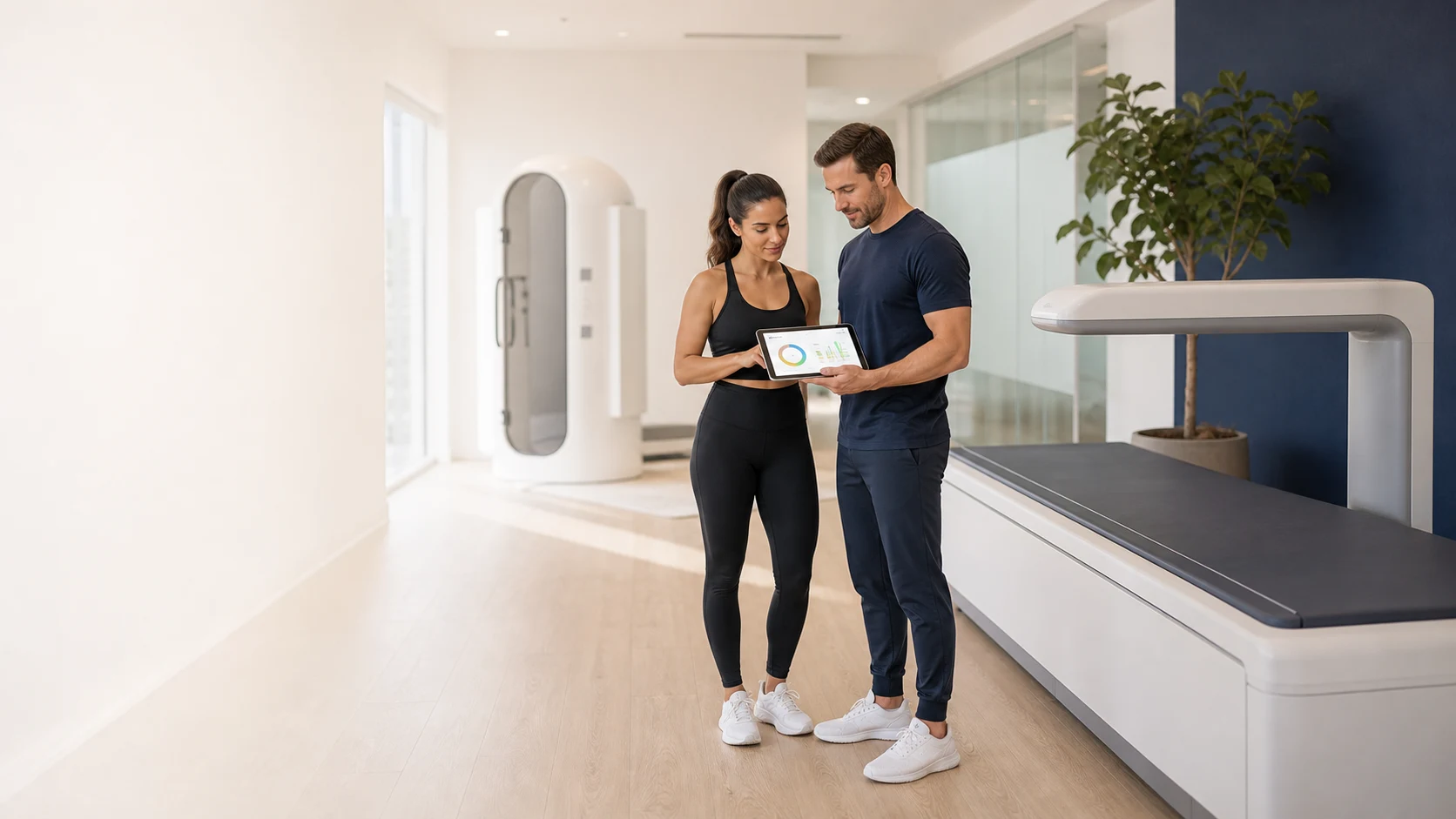
DEXA and BOD POD can both help you track body composition, but they do not produce the same kind of report. A BOD POD uses air displacement to estimate total-body density, then calculates body fat percentage and fat-free mass. A DEXA scan uses two X-ray energy levels to estimate fat mass, lean soft tissue, and bone mineral content, with regional results for areas such as the arms, legs, and trunk.
If your main question is a convenient total-body body-fat estimate, a BOD POD can be useful. If you want a detailed baseline for fat loss, muscle gain, body recomposition, or regional tracking, DEXA gives you more context.
The most important rule is not to alternate between them and treat the numerical difference as progress. They use different measurement models, so choose one method for your main trend line. If you switch methods, keep the old report for context and treat the first result from the new method as a new baseline.
For a local body-composition baseline, start with DEXA scans in Irvine and Orange County.
What does a BOD POD measure?
The BOD POD is an air-displacement plethysmography device. You sit inside a small chamber while the system measures body volume. Combined with body weight, that produces an estimate of body density. An equation then estimates body fat percentage, fat mass, and fat-free mass.
That makes the BOD POD a useful total-body method. It does not create a DEXA-style map of regional fat or lean-soft-tissue estimates, and it does not directly measure bone mineral content.
The protocol matters. The chamber measurement accounts for factors such as air around the body and in the lungs, so clothing, hair coverage, position, calibration, and the facility's instructions can affect how repeatable the appointment is. Follow the same preparation routine whenever possible.
What does a DEXA body composition scan measure?
A whole-body DEXA report separates the body into estimated fat mass, lean soft tissue, and bone mineral content. It can also show body fat percentage and regional values, depending on the scanner and report format.
That regional context is often the practical difference for someone tracking a training or nutrition phase. Instead of seeing only a single body-fat estimate, you can review total changes alongside broad arm, leg, and trunk patterns. DEXA lean soft tissue is not the same thing as pure skeletal muscle, so it is still important to interpret changes alongside training, body weight, photos, and normal hydration variation.
For a fuller explanation of the report categories, read what a DEXA body composition scan is and how to read DEXA scan results.
Why can DEXA and BOD POD body-fat numbers differ?
A different number does not automatically mean one test failed. The two methods start with different inputs and make different assumptions:
- BOD POD: estimates body volume and density, then uses a body-composition equation.
- DEXA: uses X-ray attenuation and software to estimate fat, lean soft tissue, and bone mineral components.
Because the models differ, the same person can receive two plausible but non-identical body-fat estimates. Research comparing air displacement plethysmography with DEXA has found that the direction and size of the difference can vary across body-size groups. A controlled experiment that added a known one-kilogram external fat load found that both methods detected the added total mass, while DEXA more closely assigned that added mass to fat mass in that specific test. That does not make either result a universal personal truth; it shows why raw numbers from different methods should not be mixed into one precise progress calculation.
Use one method consistently for your main trend. If your first checkpoint was a BOD POD, compare future BOD POD results with that baseline. If you choose DEXA for a baseline and follow-up milestones, compare future DEXA scans under similar conditions.
DEXA vs BOD POD for fat loss
Either method can add context beyond scale weight. The deciding question is how much detail you need from the result.
A BOD POD can be a reasonable periodic check-in when you want a total-body estimate and can repeat the same protocol. DEXA is often more useful when you want to separate estimated fat-mass and lean-soft-tissue trends, review regional context, or establish a more detailed milestone before and after a focused phase.
Neither device tells you whether a diet, training plan, or supplement plan is right for you. They can show estimates and trends that support a better conversation with a qualified coach, dietitian, or clinician when appropriate. For a goal-specific approach, see DEXA scan for fat loss tracking.
DEXA vs BOD POD for muscle gain and recomposition
For a gaining phase or body recomposition, a single body-fat percentage is rarely the whole story. You may want to know whether body weight, fat mass, and lean-soft-tissue estimates are moving in a direction that matches your plan.
That is where DEXA's broader report can be useful. It gives you total estimates plus regional context that a simple total-body density result does not provide. Still, a small change in lean soft tissue is not proof that a specific muscle grew: water, glycogen, food volume, and normal measurement variation can affect short-term readings.
Space follow-up scans far enough apart to answer a real question, and keep the scanner and preparation routine consistent. The guide to DEXA scans for muscle gain and lean mass explains how to pair the scan with performance and training records.
Which one should you choose?
Choose based on the decision you want the result to support:
- Choose a BOD POD if you want a relatively quick total-body estimate, your facility has a dependable protocol, and you plan to continue using the same method for future checks.
- Choose DEXA if you want estimated fat mass, lean soft tissue, bone mineral content, and regional context in one report.
- Choose one primary method if you care most about change over time. A clean trend from the same process is more useful than chasing the lowest or highest number across different devices.
- Start a new baseline after switching methods rather than subtracting one method's percentage from the other method's percentage.
The same continuity principle applies when two DEXA facilities use different scanners. Read can you compare DEXA scans from different machines? before treating a location or equipment change as body-composition change.
Make your follow-up scans easier to compare
Whichever method you choose, keep the routine boring and repeatable:
- Use the same device and facility when practical.
- Follow the facility's clothing and preparation instructions.
- Schedule repeat tests at a similar time of day when you can.
- Avoid making a big conclusion from one small result change.
- Keep related context, such as body weight, waist measurement, training performance, and photos, alongside the report.
The goal is not to find a perfect number. It is to create a useful baseline, follow a plan long enough for a meaningful trend, then repeat the measurement under conditions that make the comparison worthwhile.
Quick FAQ
Is DEXA more accurate than a BOD POD?
They use different models, so there is not one universal answer for every person and every goal. DEXA provides more component and regional detail in a whole-body report. For personal tracking, a consistent method and repeatable protocol are more useful than treating either device as a perfect number.
Can I compare my BOD POD result with a DEXA result?
Keep both reports, but do not calculate a precise gain or loss by subtracting one result from the other. Use the first scan from the method you plan to keep using as the baseline for that method.
Does a BOD POD measure muscle?
It estimates fat-free mass from body density. That is not a direct regional muscle measurement, and fat-free mass includes more than skeletal muscle. A DEXA report's lean-soft-tissue estimate also includes more than skeletal muscle.
Does a BOD POD measure bone density or bone mineral content?
No. A BOD POD is a body-volume and density method. It does not provide the bone mineral content component included in a whole-body DEXA report.
How often should I repeat a body composition test?
Choose an interval that gives your plan enough time to produce a meaningful result. Many active fat-loss or training phases use a baseline and a follow-up after a focused block rather than frequent short-interval testing. See how often you should get a DEXA scan for practical timing guidance.
Build a repeatable body composition baseline in Irvine
The best body-composition method is the one that gives you a useful, repeatable series—not the one that produces the most dramatic number on one day. If you want a detailed DEXA baseline for fat loss, muscle gain, or body recomposition in Irvine or Orange County, join the Founding Member List before booking opens to lock in $49 standard CLUB DEXA body composition scans for life. Expected regular pricing after launch starts at $89 per standard scan.
Sources and fine print
- NIH/PMC: Air displacement plethysmography versus DEXA across body-size groups
- NIH/PMC: Comparing detection of a known added fat mass with DEXA and air displacement plethysmography
- PubMed: Air displacement plethysmography and whole-body bone mineral density in athletes
CLUB DEXA provides body composition scans for fitness and wellness tracking. It does not diagnose conditions, determine treatment, or provide medical or nutrition advice. Body-composition estimates vary by method, device, software, protocol, and individual factors. Discuss medical questions, unexplained changes, pregnancy, or individualized training and nutrition decisions with an appropriate qualified professional.
Related articles
Should You Drink Water Before a DEXA Scan?
Learn how water intake can affect a DEXA body-composition result and how to keep repeat scans more comparable.
DEXA Scan vs Waist Measurement: What Each Can Tell You
Compare a DEXA body-composition scan with a waist measurement, including what each tracks, why the numbers are not interchangeable, and how to use both in a repeatable progress routine.
DEXA Scan vs Skinfold Calipers: Which Is Better for Body Fat Tracking?
Compare DEXA scans and skinfold calipers for body-fat tracking, including what each method measures, why the results differ, and how to choose a repeatable baseline.

Join as a Founding Member
Lock in $49 DEXA scans for life. Join the Founding Member List before booking opens in Irvine. Your standard body composition scan price will never increase, subject to additional terms. Expected regular pricing after launch starts at $89 per scan.
- $49 scans for life
- Priority launch booking
- No cost to join
No payment today. No spam. Your Founding Member price will never increase. Founding pricing applies to standard CLUB DEXA body composition scans for the registered email/account holder. Founding Member pricing includes up to 6 standard scans per calendar year. Additional scans are subject to regular pricing. Non-transferable. Excludes add-ons, bundles, third-party services, and special clinical services. Subject to appointment availability. Expected regular pricing may change before or after launch. Email verification is required before Founding Member pricing is treated as locked.