Quick answer
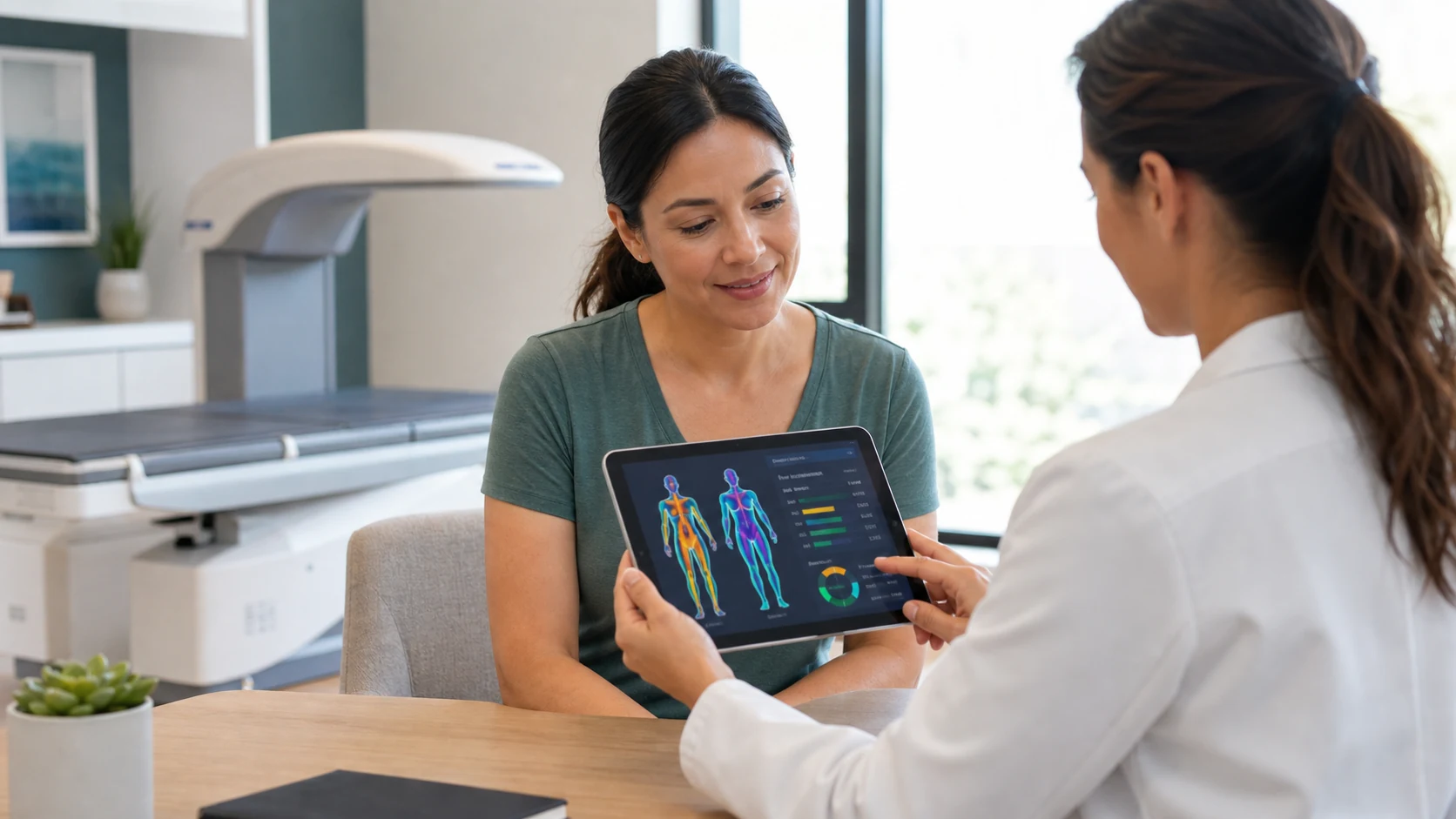
A DEXA body composition scan is a detailed way to estimate what your body weight is made of. Instead of giving you one number like a scale, it can estimate body fat percentage, fat mass, lean mass, visceral fat, and regional body composition.
DEXA stands for dual-energy X-ray absorptiometry. The technology is widely known for bone density testing, but it can also be used for body composition analysis. In a fitness and wellness setting, the goal is usually to understand how your body composition changes over time.
For people training, dieting, using clinician-guided weight loss, or tracking long-term progress, that can be far more useful than weight alone. One scan gives you a baseline. Repeat scans help you see whether fat mass, lean mass, and regional measurements are changing in the direction you want.
CLUB DEXA is opening soon in Irvine. Founding Members can lock in $49 standard DEXA body composition scans for life before booking opens, subject to additional terms, with no payment today.
What to know before you book
- Best use: baseline and follow-up tracking, not a one-time judgment.
- Main outputs: body fat percentage, fat mass, lean mass, visceral fat, and regional body composition.
- Better than BMI for body composition: BMI cannot separate fat mass from lean mass.
- Better than many smart scales for detail: DEXA provides regional and compartment estimates.
- Not a diagnosis: CLUB DEXA scans are for fitness and wellness tracking.
- Founding Member offer: $49 standard scans for life before booking opens, subject to additional terms.
What it measures
A typical DEXA body composition report may include:
- Total body fat percentage
- Total fat mass
- Lean mass
- Estimated visceral fat, when available
- Regional measurements
- Bone-related measurements
Regional results can show how estimates are distributed across areas of the body, such as arms, legs, and trunk. This matters because two people with the same body weight can have very different body compositions.
Why body fat percentage is not the whole story
Many people arrive wanting one number: body fat percentage. That number can be useful, but it should not be the only focus.
Body fat percentage is a ratio. It can change when fat mass changes, but it can also change when lean mass changes. For example, someone may improve body fat percentage by losing fat, gaining lean mass, or doing both.
That is why it is helpful to look at fat mass, lean mass, and percentage together. A complete report gives more context than a single score.
How DEXA is different from BMI
BMI compares height and weight. It can be useful for broad screening, but it does not measure body composition.
CDC notes that BMI cannot distinguish fat mass from lean body mass or show where fat is located. A muscular person and a sedentary person can have the same BMI while carrying very different amounts of fat and lean mass. DEXA gives a more individualized view because it estimates body composition rather than placing someone into a height-weight category.
How DEXA compares with smart scales
Many smart scales use bioelectrical impedance analysis. These devices are convenient, but readings can shift with hydration, food intake, exercise, and device assumptions.
DEXA is often chosen when someone wants a more detailed baseline and a clearer way to compare changes over time. No body composition method is perfect, but DEXA can provide a more complete report than many quick consumer devices.
For a direct comparison, read DEXA scan vs InBody.
What happens during a scan
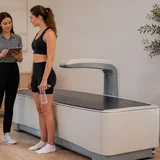
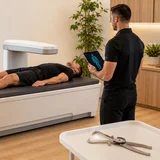
During a DEXA body composition scan, you lie still while the scanner passes over the body. The appointment is typically straightforward and noninvasive.
For better repeatability, wear similar clothing each time, avoid heavy metal items when possible, and schedule future scans under similar conditions. RadiologyInfo and CDC both emphasize loose clothing without metal for DXA imaging because metal can interfere with results.
If you are comparing scan types, it also helps to understand the difference between a body composition DEXA and a bone density DEXA.
Who benefits from DEXA?
DEXA can be useful for:
- People starting a new fitness or nutrition program
- Clients tracking fat loss without sacrificing lean mass
- Lifters measuring lean mass during a training block
- Athletes and bodybuilders planning phases around data
- Anyone who wants more context than scale weight alone
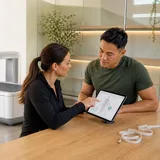
The best way to use DEXA is to treat it as a decision tool. Your first scan gives you a baseline. Your next scan shows whether your plan is moving you toward your goal.
How often to scan
Many people do well with a follow-up scan every 8 to 12 weeks during an active goal phase. Others may scan less often for maintenance or more strategically around competition milestones.
Read the full guide on how often to get a DEXA scan before choosing your schedule.
Once you have your report, use the guide on how to read your DEXA scan results to understand body fat percentage, fat mass, lean mass, and regional measurements together.
Quick FAQ
Is a DEXA body composition scan the same as a bone density scan?
No. The technology is related, but a body composition scan is used to estimate fat mass, lean mass, visceral fat, and regional composition. A medical bone density DEXA is ordered to evaluate bone health and fracture risk.
Is DEXA better than a smart scale?
For detailed body composition tracking, usually yes. Smart scales are convenient, but DEXA gives a more complete report and is less dependent on consumer-device assumptions.
Should I care more about body fat percentage or fat mass?
Look at both. Body fat percentage is a ratio, while fat mass tells you the estimated amount of fat tissue. The combination is more useful than either number alone.
How soon should I repeat my first scan?
Most people should wait long enough for a real trend to develop. During an active goal phase, that often means several weeks rather than days.
Is there payment today to join CLUB DEXA?
No. Joining the Founding Member List lets you secure the $49 standard scan price before booking opens, subject to additional terms, with no payment today.
Sources and further reading
- CDC: Facts About DEXA Scans
- Body composition with dual energy X-ray absorptiometry: from basics to new tools
- IAEA: DXA for bone mineral density and body composition assessment
The CLUB DEXA approach
CLUB DEXA focuses on helping clients turn body composition numbers into clearer tracking. The scan is not a diagnosis or a promise of results. It is a better way to understand trends and make informed fitness decisions.
The value is in repeat tracking. Your first scan gives you a baseline; follow-up scans help you compare fat mass, lean mass, visceral fat, body fat percentage, and regional changes over time.
Join the Founding Member List before booking opens to lock in $49 standard DEXA body composition scans for life at CLUB DEXA in Irvine, subject to additional terms. No payment today.
Related articles
Should You Drink Water Before a DEXA Scan?
Learn how water intake can affect a DEXA body-composition result and how to keep repeat scans more comparable.
DEXA Scan vs Waist Measurement: What Each Can Tell You
Compare a DEXA body-composition scan with a waist measurement, including what each tracks, why the numbers are not interchangeable, and how to use both in a repeatable progress routine.
DEXA Scan vs Skinfold Calipers: Which Is Better for Body Fat Tracking?
Compare DEXA scans and skinfold calipers for body-fat tracking, including what each method measures, why the results differ, and how to choose a repeatable baseline.

Join as a Founding Member
Lock in $49 DEXA scans for life. Join the Founding Member List before booking opens in Irvine. Your standard body composition scan price will never increase, subject to additional terms. Expected regular pricing after launch starts at $89 per scan.
- $49 scans for life
- Priority launch booking
- No cost to join
No payment today. No spam. Your Founding Member price will never increase. Founding pricing applies to standard CLUB DEXA body composition scans for the registered email/account holder. Founding Member pricing includes up to 6 standard scans per calendar year. Additional scans are subject to regular pricing. Non-transferable. Excludes add-ons, bundles, third-party services, and special clinical services. Subject to appointment availability. Expected regular pricing may change before or after launch. Email verification is required before Founding Member pricing is treated as locked.