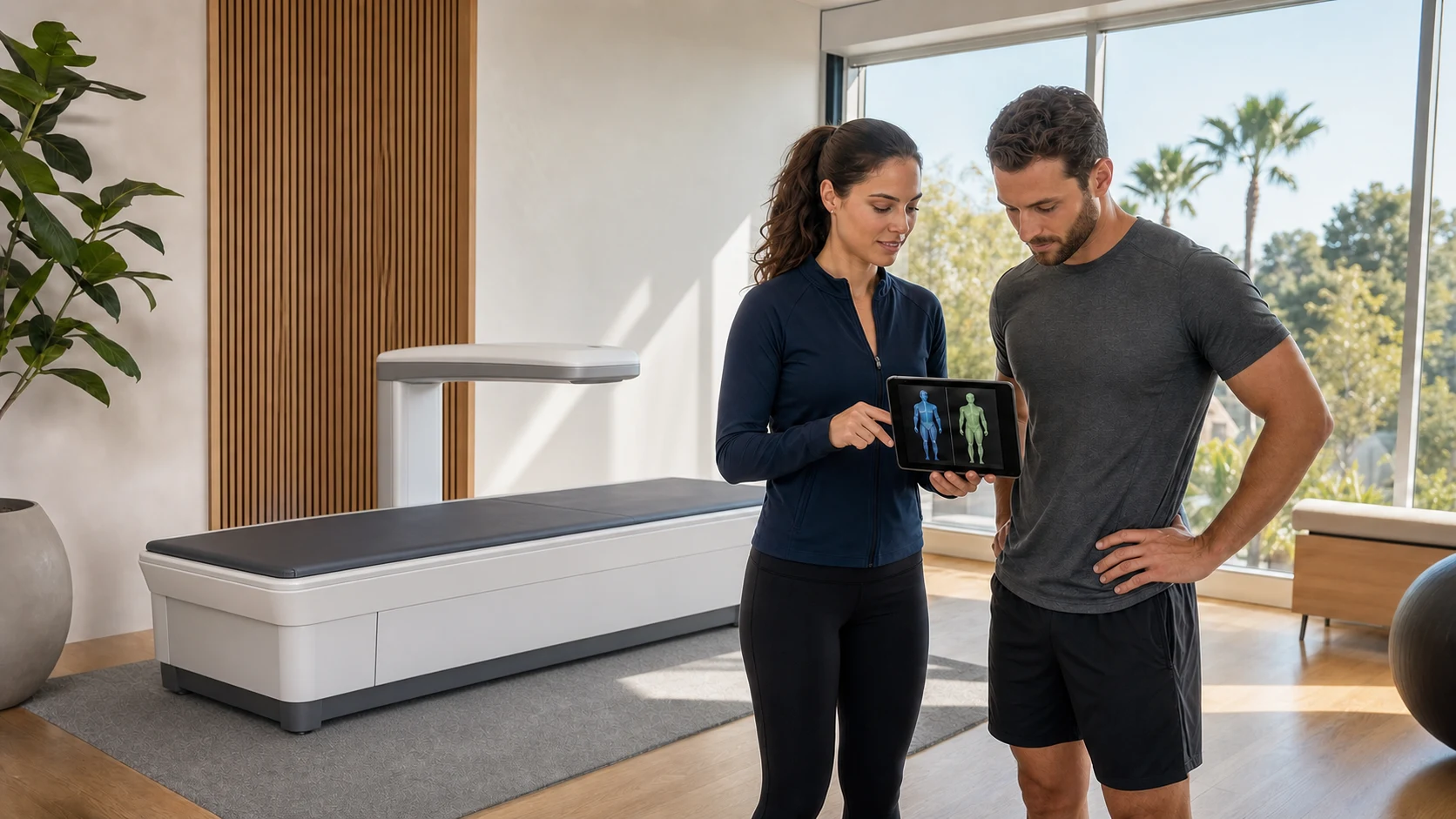
Quick answer
DEXA body composition results are easiest to compare when both scans use the same physical scanner, software, analysis method, and preparation routine.
Results from two different machines may still be comparable if the facility has properly cross-calibrated the systems for body composition. Without that work, a difference in body fat percentage, fat mass, lean mass, or a regional measurement can reflect the equipment change as well as a real change in your body.
If you must switch to a scanner that has not been cross-calibrated with the first one, keep the old report for context but treat the first result from the new machine as a new baseline. Compare future progress with that new baseline instead of subtracting the old result from the new one.
The practical comparison order
- Best: the same physical scanner, software, facility protocol, and similar scan conditions
- Potentially comparable: another system that the facility has cross-calibrated for body composition
- Use caution: the same brand or model with no confirmed cross-calibration
- New baseline: a different or unknown system with no cross-calibration information
If you are deciding whether a small change is meaningful, first review the broader guide to DEXA scan accuracy.
Why can two DEXA machines give different results?
DEXA does not place fat and muscle on a scale and weigh them directly. The scanner collects X-ray attenuation data, and its software estimates bone mineral, fat mass, and lean soft tissue from those measurements.
Several parts of that process can differ between systems:
- Scanner manufacturer and model
- Detector and beam technology
- Calibration and quality-control history
- Software version and analysis algorithm
- The boundaries used for arms, legs, trunk, android, gynoid, and other regions
- Technologist positioning and report review
Two machines can therefore track the same general body composition pattern while assigning somewhat different absolute values. A study that scanned 40 adults on both a Hologic Horizon and a GE Lunar Prodigy found strong correlations between the systems, but it also found significant differences in several fat- and lean-mass measurements.
That is why “both tests were DEXA” is not enough by itself to prove that every number is interchangeable.
What does cross-calibrated mean?
Cross-calibration is a facility-level process used to evaluate the relationship between two scanners. It is not a generic online calculator and it is not something a client can reconstruct from two personal reports.
The International Society for Clinical Densitometry says body composition changes can be evaluated between two systems of the same make and model when they have been cross-calibrated with an appropriate whole-body phantom. It also says an in-vivo cross-calibration study is needed when comparing body composition results across manufacturers.
In plain English, the facility needs evidence that the two systems agree closely enough—or a validated method for translating the results—before treating them as one continuous measurement series.
Same make and model does not automatically mean identical
Two scanners with the same name can still have different calibration histories, hardware changes, maintenance histories, or software versions. Matching the manufacturer and model reduces one source of variation, but it does not replace cross-calibration.
A software update can matter too
If the hardware stayed in place but the analysis software changed, ask the facility whether historical scans were reanalyzed or whether the update affects the values you follow. A report that looks almost identical may still have been produced by a different analysis version.
Which results deserve the most caution after a switch?
Treat every body composition comparison carefully when the equipment changes, especially:
- Total body fat percentage
- Total fat mass
- Total lean mass
- Appendicular or limb lean mass
- Android and gynoid fat
- Visceral-fat estimates
- Small left-to-right regional differences
Regional values can be especially sensitive because they depend on where the software places analysis boundaries. A small change in an arm, leg, trunk, or abdominal region may be less trustworthy across unmatched systems than a clear long-term trend measured repeatedly on one system.
This does not make either scan “wrong.” It means the two reports may use different measurement frames. Read how to interpret a DEXA report before assuming that a change in one line represents tissue gained or lost.
How to switch facilities without losing the story
Sometimes switching is unavoidable. You may move, travel, change providers, or return after a facility replaces its scanner. A careful handoff can preserve useful context even when the numerical series needs a reset.
1. Save the complete reports
Keep the full PDF or printed report from every scan, not only a screenshot of body fat percentage. The report may identify the scanner, software, scan date, total values, and regional results that help explain a later difference.
2. Ask for the scanner details
Before the new appointment, ask for the scanner manufacturer, model, and—if available—software version. Compare those details with the previous report.
3. Ask one direct calibration question
Try: “Has this scanner been cross-calibrated for body composition with the scanner used for my previous result?”
A routine daily or weekly quality-control check is important, but it is not necessarily the same as cross-calibrating two machines for client-to-client trend comparisons.
4. Match your preparation
Even on the same scanner, food, fluids, exercise, clothing, time of day, bladder status, and positioning can add noise. Follow the facility's instructions and reproduce your earlier routine as closely as practical. The guide to preparing for a DEXA scan gives you a simple consistency checklist.
5. Use the first new scan as a bridge or reset
If the scanners are cross-calibrated, the facility may be able to interpret the new report within the old series. If they are not, label the first result from the new scanner as a new baseline. Do not build a precise fat-loss or muscle-gain claim from the old-to-new difference alone.
6. Keep the next phase consistent
Once you establish the new baseline, return to the same system and repeat a similar preparation routine. A clean series on the new scanner is more useful than repeatedly bouncing between facilities in search of a preferred number.
What if the results are far apart?
Start by checking the simple explanations:
- Are the reports from the same scanner and software?
- Do both reports use the same units?
- Was one result total body fat while the other was a regional value?
- Were scan preparation and time of day similar?
- Did body weight change by a similar amount?
- Were positioning, clothing, or analysis boundaries different?
Then ask the facility to review the original scans and report settings. Do not “average” the two body fat percentages or apply a conversion equation from an unrelated research study to yourself. Published equations are built for specific machines, software versions, populations, and protocols; they are not universal corrections for personal reports.
If no valid comparison can be established, keep both reports but begin the trend again with the newer system.
Quick FAQ
Can I compare scans from two locations if they use the same model?
Maybe, but the model name alone is not enough. Ask whether the systems were cross-calibrated for body composition and whether the facilities use compatible software and analysis procedures.
Is the newer scanner automatically more accurate?
Not necessarily for your progress comparison. Newer hardware may offer technical improvements, but continuity, quality control, positioning, and cross-calibration determine whether an old-to-new change can be interpreted cleanly.
Can I compare the images even if I cannot compare the numbers?
The images and regional outlines may provide context, but they are still produced by the scanner and software. Use them as supporting information rather than a precise substitute for a matched numerical series.
Should I repeat the scan immediately on the new machine?
Usually the first scan on the new system is most useful as its baseline. Repeating again immediately rarely recreates the missing cross-calibration between facilities. Plan the next scan when enough time has passed for the result to answer a real tracking question.
Does this mean DEXA is unreliable?
No. It means measurement systems have to be used consistently. The same principle applies to many tools: a reliable progress trend depends on controlling the device and process, not merely choosing the same test category.
Build a cleaner DEXA trend in Irvine
A useful body composition series begins with a clear baseline and a repeatable process. Staying with one scanner makes fat-mass, lean-mass, and regional changes easier to interpret without wondering whether a facility change moved the numbers.
Read the local guide to DEXA scans in Irvine and Orange County, then join the Founding Member List before booking opens to lock in $49 standard CLUB DEXA body composition scans for life, subject to additional terms. Expected regular pricing after launch starts at $89 per standard scan. No payment is due today, and email confirmation is required to lock the offer.
Sources and fine print
- International Society for Clinical Densitometry: 2023 Adult Official Positions
- NIH/PMC: Comparison of two DEXA systems for body composition
CLUB DEXA provides body composition scans for fitness and wellness tracking. It does not diagnose medical conditions, determine treatment, or provide medical advice. Cross-calibration methods and the appropriateness of comparing two reports depend on the specific scanners, software, facility protocols, quality-control program, and measurements involved. Ask the facility that produced the reports for scanner-specific interpretation and discuss medical questions with an appropriate qualified healthcare professional.
Related articles
Should You Drink Water Before a DEXA Scan?
Learn how water intake can affect a DEXA body-composition result and how to keep repeat scans more comparable.
DEXA Scan vs Waist Measurement: What Each Can Tell You
Compare a DEXA body-composition scan with a waist measurement, including what each tracks, why the numbers are not interchangeable, and how to use both in a repeatable progress routine.
DEXA Scan vs Skinfold Calipers: Which Is Better for Body Fat Tracking?
Compare DEXA scans and skinfold calipers for body-fat tracking, including what each method measures, why the results differ, and how to choose a repeatable baseline.

Join as a Founding Member
Lock in $49 DEXA scans for life. Join the Founding Member List before booking opens in Irvine. Your standard body composition scan price will never increase, subject to additional terms. Expected regular pricing after launch starts at $89 per scan.
- $49 scans for life
- Priority launch booking
- No cost to join
No payment today. No spam. Your Founding Member price will never increase. Founding pricing applies to standard CLUB DEXA body composition scans for the registered email/account holder. Founding Member pricing includes up to 6 standard scans per calendar year. Additional scans are subject to regular pricing. Non-transferable. Excludes add-ons, bundles, third-party services, and special clinical services. Subject to appointment availability. Expected regular pricing may change before or after launch. Email verification is required before Founding Member pricing is treated as locked.