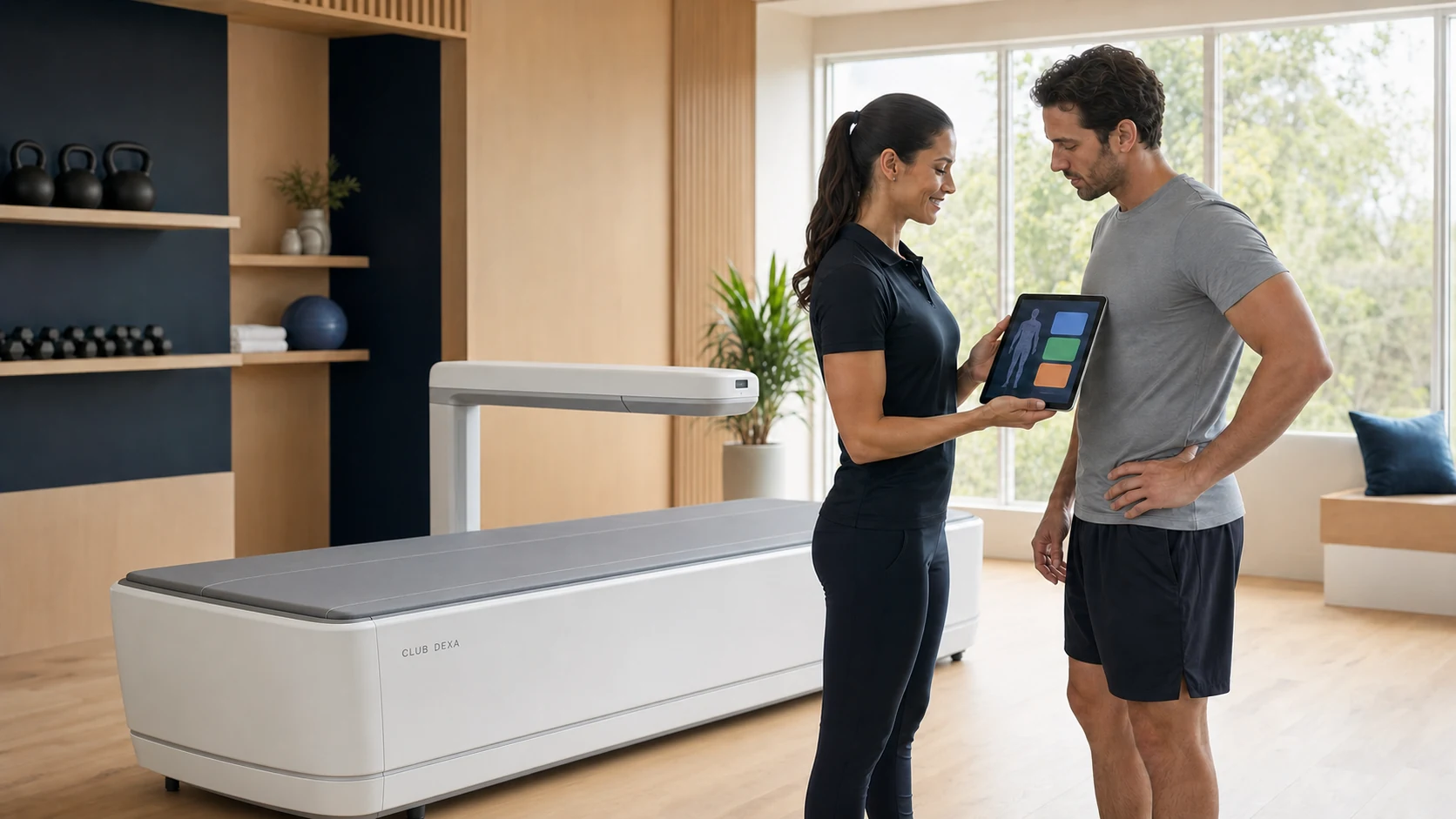
Quick answer
Bone mineral content, usually shortened to BMC, is the DEXA-estimated mass of mineral in the bones included in a scan. It is commonly reported in grams or kilograms for the total body and may also appear for regions such as the arms, legs, trunk, pelvis, ribs, and spine.
BMC is one of the three main compartments in a whole-body DEXA body composition result:
- Fat mass
- Lean soft tissue
- Bone mineral content
BMC is not the same as total bone weight, because bone also contains collagen, water, marrow, and other non-mineral material. It is also not the same as bone mineral density, or BMD. BMC is a mass; BMD relates the mineral content to the projected bone area.
For fitness and wellness tracking, BMC mainly helps you understand how the report's mass compartments fit together. It should not be used by itself to diagnose osteoporosis, estimate fracture risk, or decide on treatment.
If you are learning the full report, start with how to read your DEXA scan results.
Where BMC fits in a body composition report
A whole-body DEXA scan uses two X-ray energy levels to estimate three different components from their attenuation patterns. Current body composition methodology describes those components as fat mass, lean soft tissue, and BMC.
That makes BMC part of the body composition math, not just an extra bone-health line.
Imagine a simplified whole-body result shows:
- Fat mass: 20 kilograms
- Lean soft tissue: 50 kilograms
- Bone mineral content: 3 kilograms
The three estimated compartments total 73 kilograms. Depending on the report, you may also see:
- Lean excluding BMC: 50 kilograms in this example
- Lean including BMC: 53 kilograms
- Fat-free mass: lean soft tissue plus BMC, or 53 kilograms
The exact labels vary by scanner and software. Before comparing numbers, check whether a field includes bone mineral or describes only lean soft tissue.
This distinction also matters when reading lean mass index, ALMI, or FFMI. Two calculations can look similar while using different definitions of lean or fat-free mass.
BMC versus BMD
Bone mineral content and bone mineral density are related, but they answer different questions.
- BMC: estimated mineral mass in the measured bone region, usually in grams
- Bone area: the two-dimensional projected area of that region, usually in square centimeters
- BMD: BMC divided by projected bone area, usually in grams per square centimeter
The basic relationship is:
BMD = BMC / projected bone area
For a purely illustrative example, if a measured region had 2,500 grams of BMC across a projected area of 2,000 square centimeters, its areal BMD would be 1.25 g/cm².
That does not make BMD a three-dimensional measure of bone density. Standard DXA reports an areal value based on a two-dimensional projection, so bone size and the selected region still matter.
The practical takeaway is simple: do not read a BMC value in grams as though it were a BMD value, T-score, or Z-score. They are different outputs with different units and interpretation.
BMC is not the same as total bone weight
The word “content” matters. DEXA estimates the mineral component of bone, not the weight of the complete skeleton.
Whole bone includes more than mineral. Its organic matrix, water, marrow, and other tissues are not all counted as BMC. That is why a report showing a few kilograms of total-body BMC does not mean your skeleton weighs only that amount.
Consumer scales sometimes display a field labeled “bone mass.” That label should not be assumed to mean the same thing as DEXA BMC. Different devices use different measurement methods and prediction models. Compare like with like: DEXA BMC with DEXA BMC from a well-matched scan.
Total BMC versus regional BMC
A whole-body report may show both a total value and separate regional values.
The CDC's NHANES whole-body DXA documentation includes BMC for the total body as well as arms, legs, trunk, ribs, thoracic spine, lumbar spine, and pelvis. It also distinguishes a total value from a subtotal that excludes the head.
That creates a few comparison traps:
- Total versus subtotal: a head-included total will not match a total-body-less-head value.
- Left versus right regions: arm or leg values depend on the report's region boundaries and positioning.
- Different software labels: “total,” “subtotal,” and “total body less head” may not mean the same thing.
- Incomplete regions: a body part outside the scan field or an artifact can make a region invalid.
Before comparing two BMC values, confirm that both results use the same region definition. A regional difference is not automatically evidence of a bone-health problem, and a fitness body composition scan is not a substitute for a medical evaluation.
Why does BMC appear beside lean mass?
Bone mineral is fat-free, but it is not lean soft tissue. That is why reports may show both “lean excluding BMC” and “lean including BMC.”
Current expert terminology recommends keeping these compartments explicit:
- Lean soft tissue: non-fat, non-bone-mineral soft tissue
- BMC: estimated bone mineral mass
- Fat-free mass: lean soft tissue plus BMC
This helps explain why “lean mass” can be ambiguous across reports, apps, and research papers. One field may exclude BMC while another includes it.
If a calculated value looks unexpectedly high or low, check the definition before assuming the scan changed. The label may be the difference.
What is a good bone mineral content?
There is no single consumer BMC number that is “good” for every adult.
BMC is affected by the amount and size of bone included in the scan, so body size, age, sex, growth history, and the selected region all matter. Scanner model, software, analysis, positioning, and reference data can also affect the result.
A practical reading sequence is:
- Confirm the unit. BMC is usually reported in grams or kilograms.
- Confirm the region. Check total body, subtotal, total body less head, or a specific body region.
- Separate BMC from BMD. Do not compare grams with g/cm², a T-score, or a Z-score.
- Use matched reference context. If the report provides a comparison, make sure it applies to the same measure and population.
- Compare the full report. Read BMC beside fat mass, lean soft tissue, total mass, and any scan-quality notes.
- Use a clinician for bone-health questions. A body composition result does not establish a diagnosis or treatment need.
Can you track BMC between scans?
You can compare BMC between well-matched scans, but small short-interval differences deserve restraint.
For a cleaner comparison:
- Use the same scanner and software when possible.
- Match the region definition. Total body and total body less head are not interchangeable.
- Keep positioning consistent. Hands, arms, feet, and region boundaries affect regional analysis.
- Check for artifacts. Jewelry, metal, implants, clothing hardware, and body parts outside the scan area can affect validity.
- Review the unit and rounding. A displayed change may be smaller than it looks once rounding is considered.
- Read quality notes. Do not build a trend from a region the software marked invalid.
- Do not overread one change. Use scan precision, the size of the difference, and the broader context.
The guide to DEXA scan accuracy explains why preparation and measurement consistency matter. If you change facilities or systems, read how to compare DEXA scans from different machines before treating the values as one continuous trend.
Does whole-body BMC diagnose osteoporosis?
No. A CLUB DEXA body composition scan is designed for fitness and wellness tracking, not to diagnose osteoporosis or estimate fracture risk.
The NIH explains that clinical bone mineral density testing usually focuses on the hip and spine. Those central DXA measurements, interpreted with the appropriate T-score or Z-score and a person's medical context, are used for osteoporosis assessment.
A whole-body body composition report may include BMC or whole-body areal BMD, but those fields should not be substituted for an ordered and professionally interpreted bone-density examination.
Talk with an appropriate qualified healthcare professional if you have a history of fractures, concern about bone loss, long-term medication exposure, menopause-related risk, or another medical reason to assess bone health.
Quick FAQ
Is BMC the weight of my bones?
No. BMC estimates the mineral mass in the measured bones. It does not include every material that makes up the complete skeleton.
Is BMC the same as BMD?
No. BMC is mineral mass, usually in grams. Areal BMD relates BMC to projected bone area and is usually reported in g/cm².
Is BMC included in lean mass?
It depends on the field. “Lean soft tissue” or “lean excluding BMC” does not include it. “Lean including BMC” and fat-free mass generally do.
Why does my report show total and subtotal BMC?
The subtotal may exclude the head or use another defined set of regions. Check the report legend before comparing the values.
Can lifting weights increase BMC?
Exercise can be relevant to bone health, but one short-interval BMC change cannot prove that a specific program changed bone mineral. Training questions and medical bone-health interpretation need broader context.
Should I compare my BMC with someone else's?
Your own well-matched trend is usually easier to interpret. Cross-person comparison requires appropriate context for body size, age, sex, scanner, software, and region definition.
Build a clearer body composition baseline in Irvine
A DEXA baseline can separate fat mass, lean soft tissue, and bone mineral content so the report's totals make more sense. A consistent follow-up can then show whether fat and lean measurements moved in the intended direction without confusing BMC, BMD, and bone weight.
Read the local guide to DEXA scans in Irvine and Orange County, then join the Founding Member List before booking opens to lock in $49 standard CLUB DEXA body composition scans for life, subject to additional terms. Expected regular pricing after launch starts at $89 per standard scan. No payment is due today, and email confirmation is required to lock the offer.
Sources and fine print
- CDC/NHANES: Whole-body DXA data documentation and reported compartments
- PubMed: 2026 expert-endorsed standards for body composition methods and terminology
- NIH: Bone mineral density tests and clinical interpretation
CLUB DEXA provides body composition scans for fitness and wellness tracking. It does not diagnose osteoporosis, osteopenia, fracture risk, or other medical conditions, and it does not prescribe exercise, nutrition, supplements, or treatment. BMC values depend on the scanner, software, analysis method, selected regions, and scan quality. Discuss fractures, bone pain, medication exposure, pregnancy, or other health concerns with an appropriate qualified healthcare professional.
Related articles
Should You Drink Water Before a DEXA Scan?
Learn how water intake can affect a DEXA body-composition result and how to keep repeat scans more comparable.
DEXA Scan vs Waist Measurement: What Each Can Tell You
Compare a DEXA body-composition scan with a waist measurement, including what each tracks, why the numbers are not interchangeable, and how to use both in a repeatable progress routine.
DEXA Scan vs Skinfold Calipers: Which Is Better for Body Fat Tracking?
Compare DEXA scans and skinfold calipers for body-fat tracking, including what each method measures, why the results differ, and how to choose a repeatable baseline.

Join as a Founding Member
Lock in $49 DEXA scans for life. Join the Founding Member List before booking opens in Irvine. Your standard body composition scan price will never increase, subject to additional terms. Expected regular pricing after launch starts at $89 per scan.
- $49 scans for life
- Priority launch booking
- No cost to join
No payment today. No spam. Your Founding Member price will never increase. Founding pricing applies to standard CLUB DEXA body composition scans for the registered email/account holder. Founding Member pricing includes up to 6 standard scans per calendar year. Additional scans are subject to regular pricing. Non-transferable. Excludes add-ons, bundles, third-party services, and special clinical services. Subject to appointment availability. Expected regular pricing may change before or after launch. Email verification is required before Founding Member pricing is treated as locked.