Quick answer
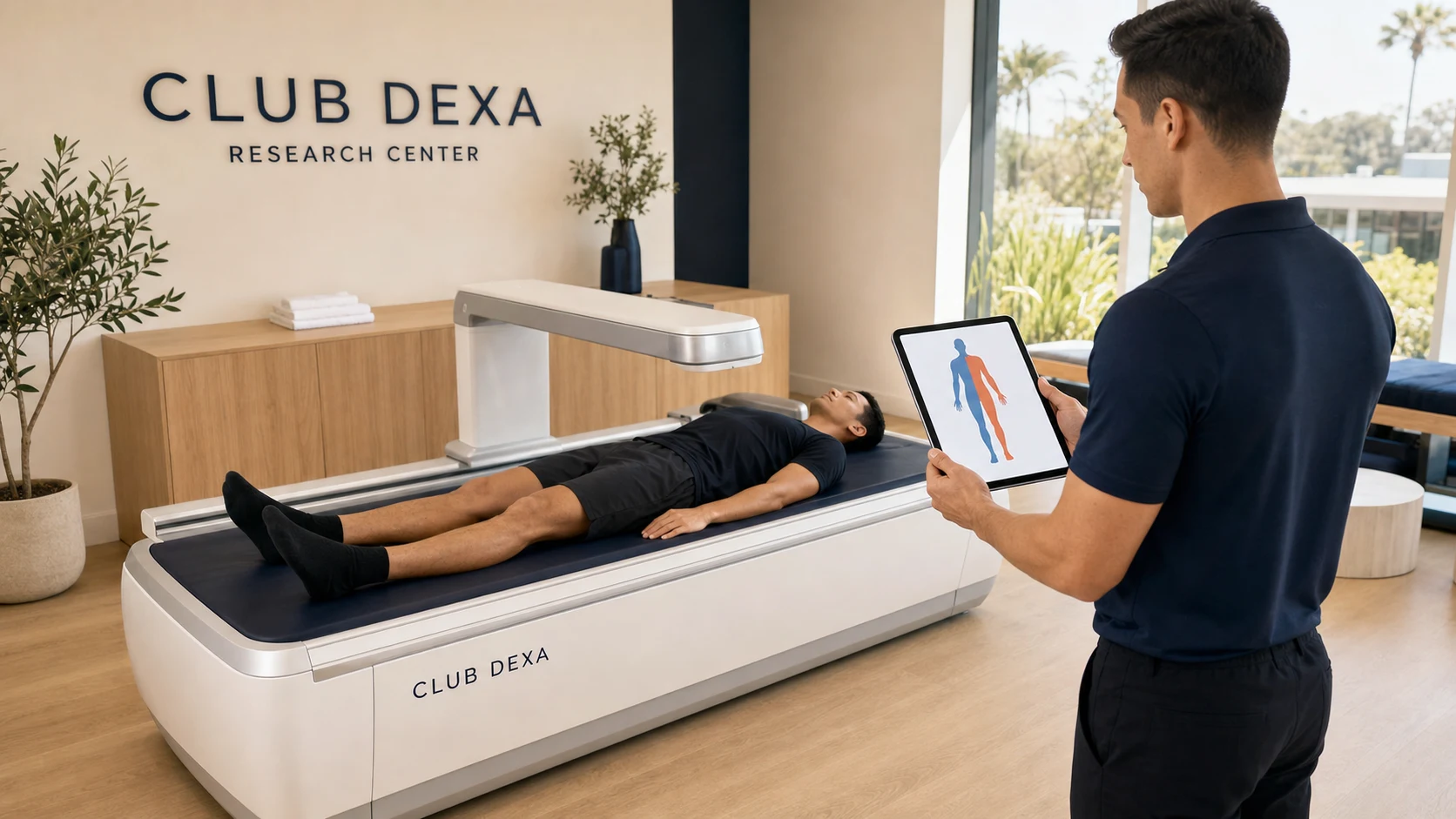
A DEXA body composition scan can estimate lean mass in your left arm, right arm, left leg, and right leg. That makes it useful for spotting a side-to-side difference, setting a baseline, and checking whether the pattern changes across a training block.
It cannot tell you by itself that you have a muscle imbalance. DEXA measures regional lean soft tissue, not strength, movement quality, injury risk, or the size of one specific muscle. A difference is a clue to review alongside unilateral lifts, performance, measurements, training history, and symptoms—not a diagnosis or an automatic reason to rewrite your program.
A practical way to use the numbers
- Start with the absolute lean mass for each arm and each leg.
- Compare left versus right within the same scan.
- Check whether the difference fits your sport, dominant side, training, or injury history.
- Repeat under similar conditions before treating a small gap as a trend.
- Pair the scan with side-specific strength or performance data.
If you are new to the report, first review how to read your DEXA scan results.
What regional lean mass actually measures
Whole-body DEXA software can divide the scan into regions such as the arms, legs, and trunk. For each region, it estimates fat mass, lean soft tissue, and bone mineral content. Comparing the left and right limbs can show whether one side contains more estimated lean tissue than the other.
Lean mass is not the same thing as pure skeletal muscle. It also reflects water and other non-fat, non-bone tissues. Research comparing DXA with whole-body MRI supports appendicular lean mass as a useful practical surrogate for arm and leg skeletal muscle, but the two measurements are not interchangeable.
That distinction matters most when a difference is small. A regional lean mass result is better read as a measurement signal than as a precise map of every muscle.
What a left-to-right difference might reflect
A regional difference can have several reasonable explanations:
- A dominant arm or leg used more often in sport or daily life
- Years of asymmetric training or sport-specific movement
- A previous period of injury, immobilization, or reduced use
- A program that intentionally gives one side more volume
- Natural anatomy and normal side-to-side variation
- Positioning, region boundaries, hydration, or short-term biological variation
The scan does not identify which explanation applies. It gives you a better question to investigate: does the tissue difference match what you see in strength, performance, movement, and training history?
Do not use one universal “imbalance” cutoff
There is no single consumer percentage that turns every left-to-right difference into a problem. The answer depends on the body region, sport, training history, measurement protocol, and the decision you are trying to make.
A 2025 study of 581 NCAA Division I athletes used custom DEXA regions for the glutes, thighs, and calves. The researchers found that typical side-to-side variation and proposed study-specific cut points differed by segment and sex. That is useful research, but it is not a universal diagnostic rule for recreational lifters or the general public.
Your most useful reference is usually your own repeatable baseline. If a difference persists or changes across scans taken under similar conditions, it becomes more informative than a one-time comparison with someone else.
Pair regional DEXA data with function
Regional lean mass describes tissue quantity. It does not describe what that tissue can do.
Pair the report with one or two side-specific measures that fit your goal, such as:
- Single-arm or single-leg training loads and repetitions
- Force, jump, sprint, or cycling data when available
- Circumference measurements taken consistently
- Training volume for each side
- Range-of-motion or movement findings from a qualified professional
- Progress photos using the same pose and lighting
For example, a small leg lean mass difference with similar unilateral strength and no symptoms may simply be a baseline characteristic. A persistent difference that also matches a clear performance gap gives you a stronger reason to review programming with a coach. Pain, weakness, or a sudden functional change belongs in a conversation with a qualified healthcare professional rather than a scan-only conclusion.
How to compare two scans
The real value of regional data appears when you repeat the measurement after enough time for meaningful change.
- Keep the setup similar. Use the same location and scanner when possible, and match time of day, hydration, meals, recent training, clothing, and positioning.
- Compare each limb with itself. Check left arm to prior left arm and right leg to prior right leg before focusing only on the gap between sides.
- Look for direction, not perfection. Ask whether the target region moved in the intended direction and whether the change agrees with performance.
- Respect measurement noise. Very small changes may reflect technical or day-to-day biological variation rather than new tissue.
- Use a meaningful training window. A full training block is usually more informative than rescanning after only a few workouts.
Research in resistance-trained adults found that consecutive-day biological variation made the threshold for meaningful whole-body lean mass change larger than same-day technical error alone. Regional values can be noisier than whole-body totals, so consistent preparation matters even more when comparing limbs.
For a broader repeatability checklist, read DEXA scan accuracy: what can affect results.
When regional lean mass is most useful
Regional DEXA data can add practical context when you are:
- Establishing a baseline before a unilateral training emphasis
- Reviewing a long hypertrophy or strength block
- Tracking a sport with a strong dominant-side pattern
- Comparing lean mass changes during body recomposition
- Returning to structured training after a period of reduced use, with appropriate professional guidance
- Checking whether a visual or strength difference also appears in body composition data
If your main goal is adding muscle, use the regional numbers as one layer of the bigger picture in DEXA scanning for muscle gain and lean mass.
What DEXA cannot tell you about asymmetry
A body composition scan cannot determine:
- Whether a difference is causing pain or injury
- Whether one side is weaker, more coordinated, or more mobile
- Which individual muscle created the regional result
- Whether you are medically cleared to train or return to sport
- Whether a tiny one-scan change is real
- What treatment or rehabilitation plan you need
That boundary does not make regional DEXA data unhelpful. It makes the data easier to use responsibly: as objective context for a training conversation, not as a stand-alone verdict.
Quick FAQ
Can DEXA measure each arm and leg separately?
Yes. Many whole-body DEXA reports estimate fat mass and lean mass separately for the left and right arms and legs. Available regions and report details can vary by scanner and software.
Is regional lean mass the same as muscle mass?
No. Lean mass includes muscle plus water and other non-fat, non-bone tissues. It is a useful muscle-related trend measure, not a direct muscle-only measurement.
Does a larger arm on DEXA mean it is stronger?
Not necessarily. Strength also depends on technique, neural factors, leverage, training specificity, pain, and other variables. Compare the scan with side-specific performance.
Can DEXA diagnose an injury from asymmetry?
No. A body composition scan does not diagnose injury or determine its cause. Seek an appropriate clinician when a difference is paired with pain, weakness, or loss of function.
Should both sides become exactly equal?
Exact symmetry is not always realistic or necessary. The better question is whether the pattern is stable, expected for your activity, and moving in a direction that supports your goal.
Use your first scan as the baseline
One regional report can identify a pattern. A well-matched follow-up can show whether that pattern changed.
If you train in Irvine or Orange County, see the local guide to DEXA scans in Irvine and use your first scan as a consistent baseline for total and regional lean mass.
Join the Founding Member List before booking opens to lock in $49 standard CLUB DEXA body composition scans for life, subject to additional terms. Expected regular pricing after launch starts at $89 per standard scan. No payment is due today, and email confirmation is required to lock the offer.
Sources and fine print
- Custom regional lower-limb lean soft tissue analysis in Division I athletes
- Total and regional skeletal muscle prediction from DXA and MRI
- Same-day versus consecutive-day DXA precision in resistance-trained athletes
CLUB DEXA provides body composition scans for fitness and wellness tracking. It does not diagnose injuries or medical conditions, prescribe treatment or rehabilitation, or determine return-to-play status. Review pain, weakness, sudden changes in function, or medical concerns with a qualified healthcare professional.
Related articles
Should You Drink Water Before a DEXA Scan?
Learn how water intake can affect a DEXA body-composition result and how to keep repeat scans more comparable.
DEXA Scan vs Waist Measurement: What Each Can Tell You
Compare a DEXA body-composition scan with a waist measurement, including what each tracks, why the numbers are not interchangeable, and how to use both in a repeatable progress routine.
DEXA Scan vs Skinfold Calipers: Which Is Better for Body Fat Tracking?
Compare DEXA scans and skinfold calipers for body-fat tracking, including what each method measures, why the results differ, and how to choose a repeatable baseline.


Join as a Founding Member
Lock in $49 DEXA scans for life. Join the Founding Member List before booking opens in Irvine. Your standard body composition scan price will never increase, subject to additional terms. Expected regular pricing after launch starts at $89 per scan.
- $49 scans for life
- Priority launch booking
- No cost to join
No payment today. No spam. Your Founding Member price will never increase. Founding pricing applies to standard CLUB DEXA body composition scans for the registered email/account holder. Founding Member pricing includes up to 6 standard scans per calendar year. Additional scans are subject to regular pricing. Non-transferable. Excludes add-ons, bundles, third-party services, and special clinical services. Subject to appointment availability. Expected regular pricing may change before or after launch. Email verification is required before Founding Member pricing is treated as locked.