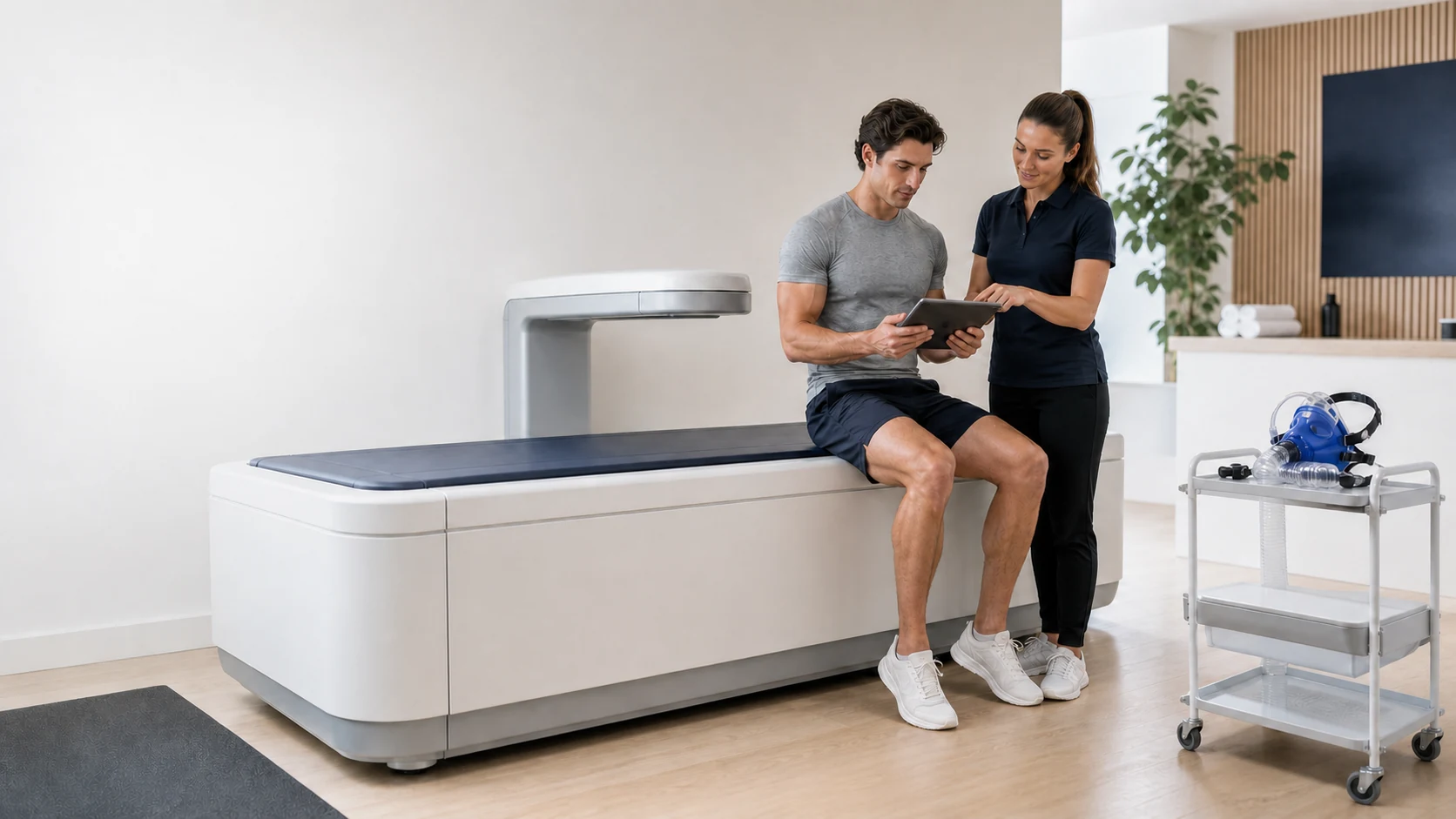
Quick answer
No. A DEXA body composition scan does not directly measure your metabolism, resting metabolic rate, total daily energy expenditure, or the number of calories you should eat.
The scan estimates fat mass, lean soft tissue, and bone mineral content. Those measurements can help software estimate resting metabolic rate because body composition is related to energy use. If an RMR or BMR number appears on a DEXA report, however, it is usually a calculated estimate—not something the scanner measured while the X-ray arm moved over the table.
That estimate can be a useful starting point when it is labeled correctly. It should not be treated as an exact calorie target or proof that your metabolism is “fast,” “slow,” “damaged,” or “fixed.”
The practical interpretation
- DEXA measures body composition: estimated fat mass, lean soft tissue, bone mineral content, and regional distribution.
- A report may estimate RMR: the software may apply an equation using body composition or basic personal data.
- Indirect calorimetry measures resting energy expenditure separately: it uses oxygen consumption and carbon dioxide production under controlled resting conditions.
- RMR is not your full daily burn: movement, training, food digestion, work, sleep, and day-to-day behavior affect total energy expenditure.
- One number is not a nutrition plan: use it alongside weight trends, training, appetite, recovery, and qualified guidance when appropriate.
If you are still learning the rest of the report, start with how to read your DEXA scan results.
What a body composition DEXA scan actually measures
DEXA uses two low-dose X-ray energies and the way different tissues attenuate those beams to estimate three broad body-composition compartments:
- Fat mass
- Lean soft tissue
- Bone mineral content
The report may also show body fat percentage, regional arm and leg values, android and gynoid distribution, and a visceral fat estimate, depending on the scanner and software.
Metabolism is different. It is a process: the energy your body uses to maintain basic functions and support activity. The DEXA image does not observe oxygen use, carbon dioxide production, heat production, thyroid function, hormone activity, or calories burned during the scan.
This is why a body composition number can inform a metabolic estimate without becoming a metabolic measurement.
Why an RMR or BMR estimate may appear on the report
Resting metabolic rate is influenced by body size and composition, so some DEXA systems use the scan result as an input to an equation. Other estimates use variables such as weight, height, age, and sex without requiring a DEXA scan at all.
Fat-free mass has a strong relationship with resting energy expenditure because lean tissues and organs require energy even at rest. But people with similar amounts of lean mass can still have different measured resting rates. The tissues inside the lean compartment are not metabolically identical, and individual biology and testing conditions add more variation.
The important question is not whether an equation is legitimate. It is whether the number on your report was measured or predicted. Look for words such as “estimated,” “predicted,” “calculated,” “RMR,” “REE,” or “BMR,” and ask what formula the report uses if the distinction is unclear.
Estimated RMR versus indirect calorimetry
An equation and an indirect calorimetry test answer the same general question in different ways.
A prediction equation
A prediction equation calculates resting energy expenditure from inputs such as weight, height, age, sex, fat-free mass, or fat mass. It is fast and useful for a starting estimate, but it is based on population relationships. The average result can be reasonable while the estimate for one person is higher or lower than their measured value.
Indirect calorimetry
Indirect calorimetry is a separate test that calculates energy expenditure from respiratory gas exchange. During a properly controlled resting test, a person breathes through a mask, canopy, or mouthpiece while the system measures oxygen consumption and carbon dioxide production.
Test conditions matter. Recent food, exercise, caffeine, nicotine, stress, sleep, room conditions, rest time, and device protocol can affect the result. A measured value is more individualized than a prediction equation, but it still reflects the conditions and time of that test.
Neither number automatically tells you total daily energy expenditure. Total daily needs also include physical activity, training, spontaneous movement, and the energy used to digest food.
Does more lean mass mean a faster metabolism?
Usually, more fat-free mass is associated with higher resting energy expenditure. That relationship is real, but the internet version—“muscle burns a huge number of calories at rest”—is often exaggerated.
DEXA lean soft tissue is also broader than skeletal muscle. It includes water, protein, organs, connective tissue, and other non-fat, non-bone components. A change in hydration or glycogen can move the lean-mass estimate without creating an equivalent change in resting energy use.
Use the scan to answer a body-composition question first:
- Did fat mass change?
- Did lean soft tissue change?
- Did the regional pattern change?
- Were the scan conditions similar enough to compare?
Then decide whether an RMR estimate adds useful context. For the measurement distinction, read DEXA scanning for muscle gain and lean mass and what can affect DEXA scan accuracy.
How to use a DEXA-based RMR estimate without overreading it
Treat the estimate as a starting hypothesis, then compare it with real-world trends.
1. Confirm what the number represents
Check whether the report says RMR, REE, or BMR and whether the value is measured or estimated. Do not assume the DEXA machine directly measured calories because the number appears beside scan data.
2. Keep resting and daily expenditure separate
Resting expenditure is only one part of a day. An activity multiplier can create a rough daily estimate, but work, steps, training, and spontaneous movement vary widely.
3. Watch the trend you can observe
Body weight, fat mass, waist measurements, training performance, recovery, hunger, and intake consistency show whether a plan is behaving as expected over time. Short-term scale movement can still reflect water, glycogen, food volume, and other noise.
4. Adjust carefully
A small calculated mismatch is not proof of a broken metabolism. If the trend consistently differs from the plan, review tracking accuracy, time horizon, activity, recovery, medications, and the assumptions behind the estimate before making a large change.
5. Use qualified support when the decision is higher-stakes
A registered dietitian or other appropriate qualified professional can help translate energy-expenditure information into an individualized plan, especially when medical conditions, medications, pregnancy, disordered-eating concerns, or performance demands are involved.
Can repeat DEXA scans show a metabolism change?
Repeat scans can show a body-composition change. They cannot prove exactly how much your metabolism changed or why.
For example, a longer training phase may add lean tissue, while a fat-loss phase may reduce both fat mass and some lean soft tissue. Those changes can affect a prediction equation. But a new estimated RMR on the report is still the output of a formula using new inputs, not a second direct metabolic test.
If you want to compare body composition across scans, match preparation and scan conditions as closely as practical. If you want to compare measured resting energy expenditure, the calorimetry protocol also needs to be consistent. Do not mix a DEXA estimate from one date with an indirect calorimetry measurement from another and treat them as the same test.
Quick FAQ
Does DEXA calculate BMR?
Some DEXA reports display an estimated BMR or RMR. The available value and formula depend on the scanner and software. The body composition scan itself does not directly measure energy expenditure.
Is RMR the same as BMR?
They describe closely related resting energy concepts, but BMR traditionally uses stricter testing conditions. Consumer reports sometimes use the terms loosely, so focus on how the value was obtained.
Can DEXA tell me how many calories to eat?
No. A report may provide a resting estimate, but calorie needs also depend on activity, goals, health context, adherence, and how your body responds over time.
Can DEXA diagnose a slow metabolism?
No. A body composition scan cannot diagnose a metabolic, endocrine, or other medical condition. Bring persistent symptoms or health concerns to an appropriate clinician.
Is indirect calorimetry always exact?
It is a measurement rather than a population equation, but device quality, protocol, resting conditions, and day-to-day variation still matter. It should be interpreted within the conditions of the test.
Build a body composition baseline in Irvine
If your real goal is to understand whether a nutrition or training phase is changing fat mass and lean soft tissue, a consistent DEXA baseline can be more actionable than chasing one calorie estimate.
See the local guide to DEXA scans in Irvine and Orange County, then join the Founding Member List before booking opens to lock in $49 standard CLUB DEXA body composition scans for life, subject to additional terms. Expected regular pricing after launch starts at $89 per standard scan. No payment is due today, and email confirmation is required to lock the offer.
Sources and fine print
- Open-access review: body composition with dual-energy X-ray absorptiometry
- PubMed: Mifflin–St Jeor resting energy expenditure equation
- PubMed: indirect calorimetry principles and interpretation
CLUB DEXA provides body composition scans for fitness and wellness tracking. It does not measure resting energy expenditure, prescribe calorie intake, diagnose metabolic or medical conditions, or provide medical or nutrition advice. Discuss individualized calorie targets, unexplained symptoms, medications, pregnancy, or health concerns with an appropriate qualified professional.
Related articles
Should You Drink Water Before a DEXA Scan?
Learn how water intake can affect a DEXA body-composition result and how to keep repeat scans more comparable.
DEXA Scan vs Waist Measurement: What Each Can Tell You
Compare a DEXA body-composition scan with a waist measurement, including what each tracks, why the numbers are not interchangeable, and how to use both in a repeatable progress routine.
DEXA Scan vs Skinfold Calipers: Which Is Better for Body Fat Tracking?
Compare DEXA scans and skinfold calipers for body-fat tracking, including what each method measures, why the results differ, and how to choose a repeatable baseline.


Join as a Founding Member
Lock in $49 DEXA scans for life. Join the Founding Member List before booking opens in Irvine. Your standard body composition scan price will never increase, subject to additional terms. Expected regular pricing after launch starts at $89 per scan.
- $49 scans for life
- Priority launch booking
- No cost to join
No payment today. No spam. Your Founding Member price will never increase. Founding pricing applies to standard CLUB DEXA body composition scans for the registered email/account holder. Founding Member pricing includes up to 6 standard scans per calendar year. Additional scans are subject to regular pricing. Non-transferable. Excludes add-ons, bundles, third-party services, and special clinical services. Subject to appointment availability. Expected regular pricing may change before or after launch. Email verification is required before Founding Member pricing is treated as locked.