Quick answer
DEXA and CT can both add body-composition context, but they work at different levels and serve different decisions. A whole-body DEXA scan estimates fat mass, lean soft tissue, and bone mineral content, often with broad regional results. CT creates detailed cross-sectional X-ray images that can distinguish anatomical tissues such as skeletal muscle and adipose tissue in a selected body area.
For a person building a practical baseline before a fat-loss, muscle-gain, or body-recomposition phase, a DEXA scan is usually the more direct fit. CT is generally a diagnostic imaging study ordered for a medical reason; body-composition analysis may be performed from an existing CT image in a clinical setting. Do not treat a CT result as a conversion table for a DEXA report—or seek a CT solely to get a fitness body-composition number.
If you are building that repeatable baseline in Irvine or Orange County, start with DEXA Scan in Irvine & Orange County.
What a DEXA body-composition scan estimates
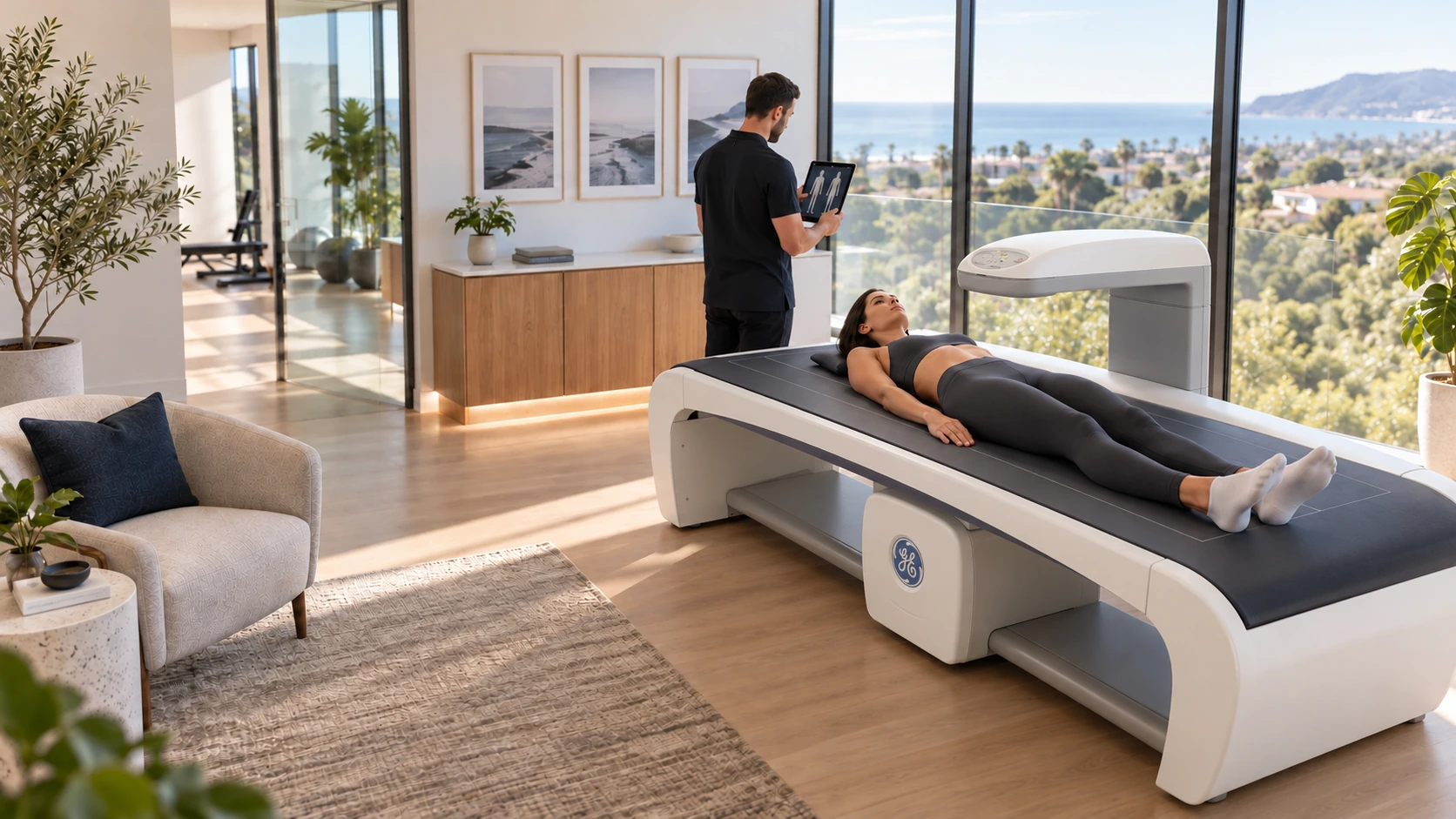
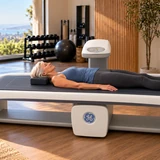
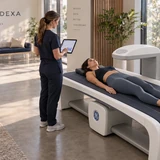
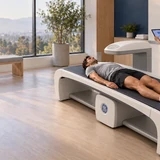
A whole-body DEXA scan uses two X-ray energy levels and software to estimate three broad components of measured mass:
- Fat mass: the estimated mass attributed to fat.
- Lean soft tissue: non-fat, non-bone soft tissue. It includes muscle, but also water and other tissue.
- Bone mineral content: the mineral component reported separately from soft tissue.
The International Society for Clinical Densitometry's adult positions list total mass, total lean mass, total fat mass, percent fat mass, and bone mineral content among the information that should appear on adult total-body reports. Depending on the scanner and software, a report may also provide broad arm, leg, and trunk results or optional measures such as visceral-fat estimates.
That makes DEXA useful for a whole-body progress question: is estimated fat mass moving in the intended direction, is lean soft tissue relatively stable during a cut, or does the follow-up fit with your scale trend, training, and measurements? For a plain-English tour of a report, read How to Read Your DEXA Scan Results.
What CT can add
CT uses X-rays to make cross-sectional images of the body. In body-composition research and clinical care, specialized analysis can use those images to identify anatomical tissues and compartments—such as skeletal muscle, visceral adipose tissue, subcutaneous adipose tissue, or tissue inside and between muscle groups—within the scanned region.
That is a different job from a standard whole-body DEXA report. The 2026 expert guide in the *American Journal of Clinical Nutrition* describes CT as a tissue- and organ-level method with high spatial detail. It notes that CT-based body-composition analysis is commonly used in clinical populations, often by analyzing scans that were already obtained for diagnosis or treatment monitoring. A single abdominal image is frequently analyzed near the third lumbar vertebra, rather than becoming a consumer whole-body fitness report.
CT's anatomical detail can be important when a clinician has a specific reason to evaluate an existing scan. It does not mean that a fitness-focused DEXA scan can diagnose an injury, disease, low muscle mass, or tissue quality—or that a person should request a CT scan just to inspect a body-composition trend.
Why a CT result and a DEXA result do not match number for number
The key difference is the model behind each result.
- DEXA estimates broad whole-body components. Its standard categories include fat mass, lean soft tissue, and bone mineral content.
- CT identifies anatomical tissue in the imaged area. A CT analysis may report skeletal-muscle area or specific adipose-tissue compartments at a selected body landmark.
- Lean soft tissue is not skeletal muscle alone. A DEXA lean-soft-tissue value includes water and other non-fat, non-bone tissue. It should not be relabeled as a CT muscle measurement.
- Location and protocol matter. A CT result may come from one slice or one clinical exam, while DEXA uses its own scanner software and region definitions for a whole-body estimate.
Those methods can be individually useful, but they are not interchangeable. Avoid trying to calculate muscle gained or fat lost by subtracting a CT tissue-area value from a DEXA lean-mass or fat-mass value. For a personal trend, repeated measurements from the same method under similar conditions are usually more interpretable.
If your main question is about estimated lean-soft-tissue trends during training, DEXA Scan for Muscle Gain and Lean Mass explains how to make the comparison more useful.
Radiation and the reason for the exam
Both modalities use X-rays, but their radiation exposure and purpose differ substantially. The American College of Radiology and Radiological Society of North America's dose guide lists typical effective doses for bone densitometry and several CT exams to illustrate that difference. It also stresses that actual dose varies with the person, body area, protocol, and imaging practice.
That is why the question is not simply, "Which scan is more detailed?" A CT can be the right study when a qualified clinician needs diagnostic imaging. A DEXA body-composition scan can be a practical low-exposure, repeatable checkpoint when the question is about a fitness or wellness trend. Neither scan should be ordered, repeated, or interpreted as medical advice outside an appropriate clinical decision.
For a focused explanation of DEXA's low-dose X-ray component, see How Much Radiation Is in a DEXA Body Composition Scan?.
Choose the method by the question you need answered
Start with the decision you are trying to make.
- "I want a whole-body baseline before a focused training or nutrition phase." A DEXA scan can provide estimated fat mass, lean soft tissue, bone mineral content, and broad regional context to revisit after a meaningful block.
- "I want to compare body composition over time." Use the same DEXA location and scanner when practical, and keep preparation reasonably consistent. That gives the trend the best chance of being useful.
- "My clinician ordered CT imaging for a medical concern." Follow the clinician's plan. If body composition is relevant, ask the clinical team what the exam can and cannot answer; CLUB DEXA does not interpret diagnostic imaging.
- "I want a detailed look at a specific muscle, organ, symptom, or injury." That is a medical-imaging question, not a substitute use for a fitness DEXA report.
The right tool is the one that answers the real question without creating a false comparison. A DEXA baseline is not a diagnosis, and an existing CT report is not automatically a better version of a DEXA result.
How to make a DEXA trend more useful
The value of a baseline is in the comparison that follows. You do not need identical days, but reducing avoidable differences makes a close change easier to interpret.
- Use the same scanner and facility when practical.
- Schedule follow-ups at a similar time of day.
- Keep clothing, hydration, meal timing, and recent hard training reasonably similar.
- Compare after a meaningful, consistent block rather than a few unusually strict days.
- Read estimated fat mass and lean soft tissue beside scale weight, measurements, training performance, and recovery.
The 2026 expert body-composition standards likewise emphasize clear terminology, standardized measurement protocols, and thoughtful longitudinal interpretation. For a practical appointment checklist, use How to Prepare for a DEXA Scan.
Quick FAQ
Is CT more accurate than DEXA for body composition?
Neither method wins without naming the tissue, body area, and decision. CT can provide detailed anatomical tissue information in the imaged area. DEXA provides a practical whole-body estimate of fat mass, lean soft tissue, and bone mineral content. Their outputs should not be used as a direct accuracy scorecard.
Can a CT scan show muscle that DEXA cannot?
CT can distinguish anatomical skeletal muscle and related tissue characteristics in an imaged area. DEXA reports lean soft tissue, which includes muscle but is not muscle-only. A CT finding needs clinical context; a DEXA trend can still be useful for a whole-body fitness baseline.
Should I get a CT scan to track fat loss or muscle gain?
Not solely for that purpose. CT is generally performed for a clinical reason, and additional CT imaging for a fitness number can add unnecessary radiation and cost. If you want a repeatable body-composition trend, discuss the appropriate option with a qualified clinician or use a DEXA baseline for its intended wellness-tracking role.
Can DEXA diagnose a muscle injury or medical condition?
No. A body-composition DEXA scan does not diagnose injuries, explain symptoms, or determine treatment. Seek appropriate medical evaluation for pain, weakness, unexplained changes, or other health concerns.
Can I compare an older CT report with a new DEXA scan?
You can keep both as context, but do not calculate a precise change by subtracting their values. Ask the clinician who ordered the CT what it reported, then start a DEXA baseline-and-follow-up series if that serves your non-diagnostic fitness goal.
Build a baseline you can use in Irvine
If your goal is to track a focused body-composition phase rather than answer a diagnostic imaging question, a DEXA baseline can make the next milestone clearer. Compare DEXA Scan Cost in Orange County, then join the Founding Member List before booking opens to lock in $49 standard CLUB DEXA body composition scans for life, subject to additional terms. Expected regular pricing after launch starts at $89 per standard scan. No payment is due today, and email confirmation is required before Founding Member pricing is treated as locked.
Sources and fine print
- International Society for Clinical Densitometry: 2023 Official Adult Positions
- American Journal of Clinical Nutrition: Methodological standards for body composition assessment
- RadiologyInfo.org: Radiation Dose from X-Ray and CT Exams
CLUB DEXA provides body-composition scans for fitness and wellness tracking. It does not diagnose injuries or medical conditions, prescribe treatment, provide medical advice, or interpret CT or other diagnostic imaging. DEXA estimates can vary by scanner, software, protocol, and individual testing conditions. Discuss symptoms, pregnancy, radiation concerns, existing diagnostic imaging, and individualized health questions with an appropriate qualified healthcare professional.
Related articles
DEXA Scans for Healthy Aging: What to Track
Learn how older adults can use a DEXA body-composition baseline alongside strength, movement, and clinical care.
DEXA Scan and PCOS: What a Body-Composition Baseline Can Tell You
Learn what a DEXA body-composition baseline can track with PCOS, what it cannot diagnose, and how to use repeat scans without reducing your health to one number.
DEXA Scans for Endurance Athletes: What to Track
Learn how runners, cyclists, and triathletes can use DEXA body-composition scans as repeatable checkpoints without confusing a scan with a performance or health diagnosis.

Join as a Founding Member
Lock in $49 DEXA scans for life. Join the Founding Member List before booking opens in Irvine. Your standard body composition scan price will never increase, subject to additional terms. Expected regular pricing after launch starts at $89 per scan.
- $49 scans for life
- Priority launch booking
- No cost to join
No payment today. No spam. Your Founding Member price will never increase. Founding pricing applies to standard CLUB DEXA body composition scans for the registered email/account holder. Founding Member pricing includes up to 6 standard scans per calendar year. Additional scans are subject to regular pricing. Non-transferable. Excludes add-ons, bundles, third-party services, and special clinical services. Subject to appointment availability. Expected regular pricing may change before or after launch. Email verification is required before Founding Member pricing is treated as locked.