Quick answer
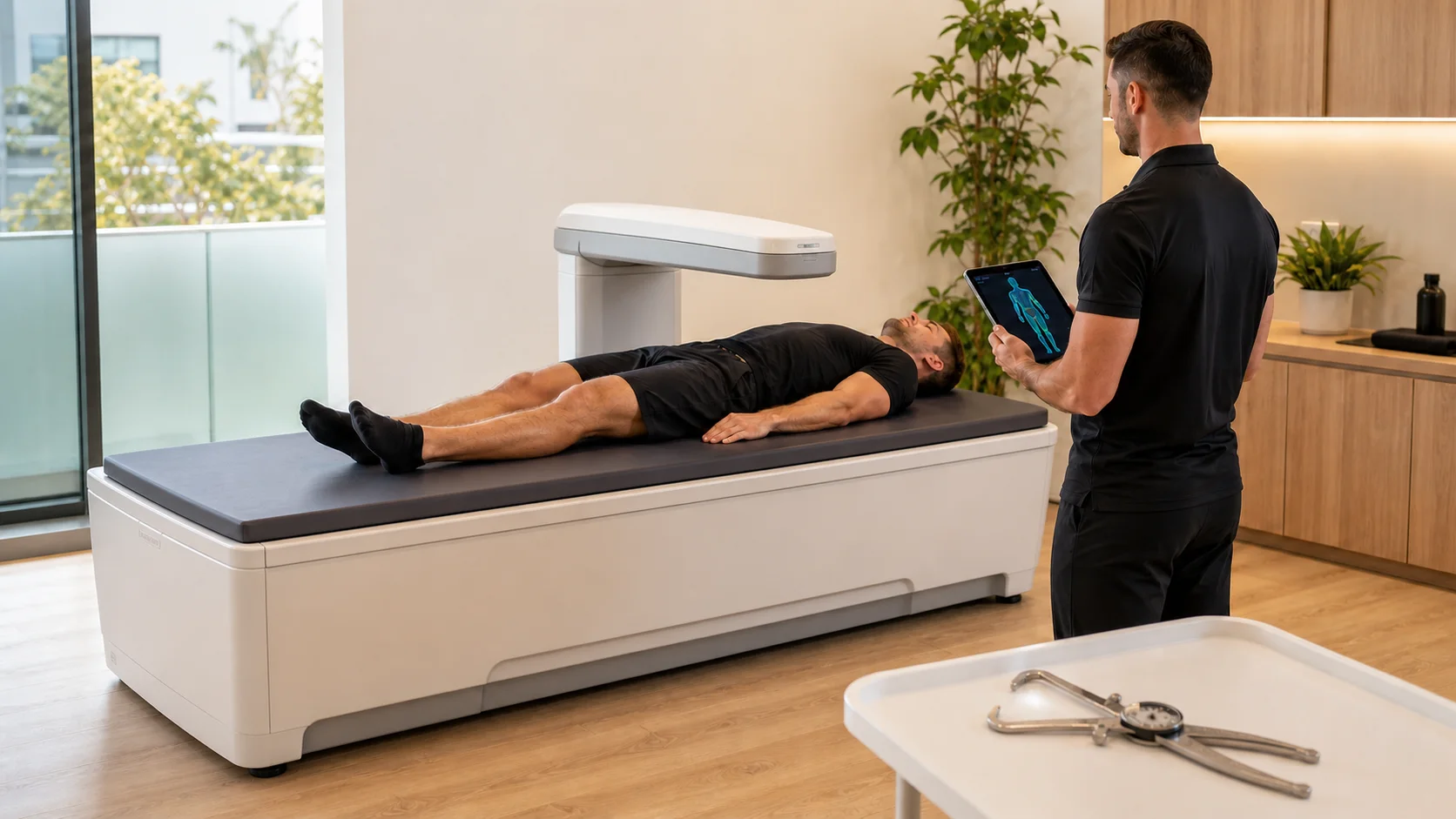
Skinfold calipers track the thickness of skin and underlying fat at selected sites. A DEXA body-composition scan estimates fat mass, lean soft tissue, and bone mineral content across the whole body. Both can be useful, but they answer different questions and should not be swapped back and forth in one progress chart.
Skinfolds can be a practical choice when you have access to the same skilled tester, the same sites, and the same protocol. They are portable, fast, and often useful for tracking a sum of skinfolds over time. A DEXA scan is usually the better fit when you want a detailed whole-body baseline, including estimated fat mass, lean soft tissue, bone mineral content, and broad regional context in one report.
The useful choice is rarely the method with the most impressive single number. It is the one you can repeat under similar conditions and use to answer your actual question. If you are building a local DEXA baseline, start with DEXA Scan in Irvine & Orange County.
What skinfold calipers measure
Skinfold testing uses calipers to measure the thickness of a pinch of skin and subcutaneous tissue at standardized body sites. A tester may take several readings at sites such as the triceps, abdomen, thigh, chest, or suprailiac area, depending on the protocol. Those readings can be used in two ways:
- A sum of skinfolds: a direct total of the measured site thicknesses, useful as a repeatable field metric.
- An estimated body-fat percentage: a result calculated from the readings with a population-specific equation.
That distinction matters. A sum of skinfolds is not the same thing as whole-body body-fat percentage, and an equation-based percentage is not a DEXA result in another format. The tester’s landmarking, pinch technique, caliper pressure, chosen sites, and equation all affect what the final number represents.
Skinfolds can be especially practical in a coached setting where the same experienced person uses the same protocol each time. They are inexpensive, travel well, and can make a simple trend visible without needing a scan appointment. The tradeoff is that they do not provide a DEXA-style report of total fat mass, lean soft tissue, bone mineral content, or regional values.
What a DEXA body-composition scan measures
A whole-body DEXA scan uses two X-ray energy levels and software to estimate three broad components: fat mass, lean soft tissue, and bone mineral content. The International Society for Clinical Densitometry's current adult positions list total mass, total lean mass, total fat mass, percent fat mass, and bone mineral content among the values that should appear on adult total-body reports.
That makes DEXA a different kind of checkpoint. Depending on the scanner and report format, a DEXA body-composition scan may help you review:
- Estimated total fat mass and body-fat percentage
- Estimated lean soft tissue
- Bone mineral content
- Broad arm, leg, and trunk regions
- Available regional estimates, such as android/gynoid or visceral-fat values
DEXA lean soft tissue is not pure skeletal muscle, and no body-composition method can identify why a value changed. Food, hydration, recent exercise, positioning, analysis settings, and normal measurement variation can affect close comparisons. For a plain-English guide to the report, see How to Read Your DEXA Scan Results.
Why a skinfold result and DEXA result can differ
It is normal for skinfold-derived and DEXA-derived body-fat percentages to differ. They start with different observations and use different models:
- Skinfold calipers: measure thickness at selected surface sites, then often use an equation to estimate a whole-body percentage.
- DEXA: uses X-ray attenuation and software to estimate fat mass, lean soft tissue, and bone mineral content across the body.
Research in trained male athletes found significant differences among estimates obtained by DEXA, bioelectrical impedance, and skinfold thickness measurements. More broadly, an applied-sport review emphasizes that body-composition methods have different practical strengths and limitations rather than one universally perfect personal truth. The athlete comparison study and the applied-sport methods review are useful reminders that correlation between methods does not make their numbers interchangeable.
Do not subtract a skinfold-derived percentage from a DEXA percentage and call the gap progress or error. If you switch methods, save the older result for context and treat the first result from the new method as a fresh baseline.
Choose skinfolds when a simple field trend fits your goal
Skinfolds can be a strong practical option when the goal is a consistent, low-friction field measurement. They may fit when:
- Your coach or qualified tester uses the same sites, calipers, and procedure every time.
- You want to monitor a sum of skinfolds during a training block or contest-prep phase.
- You prefer an inexpensive check-in that can travel to a gym, team setting, or training camp.
- You understand that an equation-based body-fat percentage is an estimate tied to that protocol.
For skinfold tracking, consistency is the product. Keep the tester, sites, calipers, and protocol as stable as practical. Record whether you are tracking a sum of skinfolds or an equation-derived percentage so you do not confuse the two later.
Choose DEXA when you want a fuller baseline
DEXA is often the better fit when you want more context than a few surface-site readings can provide. Consider a DEXA scan when questions such as these matter to you:
- Did a fat-loss phase change estimated fat mass while lean soft tissue stayed reasonably stable?
- Is scale weight flat while estimated body composition is changing?
- Would broad arm, leg, and trunk values give useful context for your training phase?
- Do you want estimated bone mineral content beside fat and lean-soft-tissue values?
- Are you establishing a baseline before a muscle-gain, body-recomposition, or guided weight-loss phase?
A DEXA scan is not a training prescription or a diagnosis. It is a more detailed checkpoint to use alongside body weight, performance, measurements, photos, and appropriate professional guidance. For a closely related use case, read DEXA Scan for Body Recomposition: When the Scale Stalls.
Make either method more useful over time
The most helpful trend usually comes from making the comparison boringly consistent. For either method:
- Use one primary method for a focused phase instead of alternating between methods.
- Repeat at a similar time of day when you can.
- Keep meal timing, hydration, and hard training reasonably similar before comparable checkpoints.
- Save the whole report or the full skinfold log, not only one headline number.
- Recheck after a meaningful training or nutrition phase rather than reacting to tiny short-term changes.
For DEXA, consistent preparation and positioning are specifically important for precision, according to the ISCD. How to Prepare for a DEXA Scan can help you keep avoidable scan-day noise out of the comparison. If you are deciding among several common methods, see Best Body Fat Test Near Irvine: DEXA vs InBody.
Quick FAQ
Are skinfold calipers more accurate than DEXA?
Neither method creates an infallible personal truth. Skinfolds can be very useful when an experienced tester repeats the same protocol. DEXA provides a broader whole-body estimate and report. For personal tracking, a repeatable method and clean baseline are usually more useful than trying to force two methods to agree exactly.
Can I compare a skinfold body-fat percentage with a DEXA percentage?
Keep both records, but do not calculate a precise gain or loss by subtracting one from the other. Treat the first result from the method you plan to keep using as that method's baseline.
Do skinfold calipers measure visceral fat or bone mineral content?
No. Skinfold calipers measure selected surface sites. They do not produce DEXA-style estimates of visceral fat, bone mineral content, or whole-body regional composition.
Can DEXA tell me exactly how much muscle I gained?
No. DEXA estimates lean soft tissue, which includes more than skeletal muscle. It can be a useful component of a broader progress review, especially when paired with your training, performance, and body-weight context.
How often should I repeat a body-composition check?
Repeat after your plan has had time to produce a useful signal. A baseline and follow-up after a focused phase are often more useful than frequent short-interval checks. When to Recheck a DEXA Scan After Starting a New Plan has a goal-based timing framework.
Build a useful baseline in Irvine
If you want a fuller body-composition baseline before a fat-loss, muscle-gain, or recomposition phase, CLUB DEXA is built for repeatable milestones in Irvine and Orange County. A DEXA report can give you estimated fat mass, lean soft tissue, bone mineral content, and regional context to use beside your training and day-to-day progress.
Read DEXA Scan Cost in Orange County, then join the Founding Member List before booking opens to lock in $49 standard CLUB DEXA body composition scans for life, subject to additional terms. Expected regular pricing after launch starts at $89 per standard scan. No payment is due today, and email confirmation is required before Founding Member pricing is treated as locked.
Sources and fine print
- International Society for Clinical Densitometry: 2023 Official Adult Positions
- PubMed: Body composition measurement in highly trained male athletes
- NIH/PMC: Skinfolds and other body-composition methods in applied sport
- NIH/PMC: Body composition with dual-energy X-ray absorptiometry
CLUB DEXA provides body-composition scans for fitness and wellness tracking. It does not diagnose medical conditions, determine treatment, or provide medical or nutrition advice. Body-composition estimates can vary by method, device, software, equation, protocol, and individual factors. Discuss medical questions, pregnancy, unexplained changes, or individualized training and nutrition decisions with an appropriate qualified professional.
Related articles
Should You Drink Water Before a DEXA Scan?
Learn how water intake can affect a DEXA body-composition result and how to keep repeat scans more comparable.
DEXA Scan vs Waist Measurement: What Each Can Tell You
Compare a DEXA body-composition scan with a waist measurement, including what each tracks, why the numbers are not interchangeable, and how to use both in a repeatable progress routine.
DEXA Scan vs Hydrostatic Weighing: Which Is Better for Body Fat?
Compare DEXA and hydrostatic weighing for body-fat tracking, including what each method estimates, why results can differ, and how to choose a repeatable baseline.

Join as a Founding Member
Lock in $49 DEXA scans for life. Join the Founding Member List before booking opens in Irvine. Your standard body composition scan price will never increase, subject to additional terms. Expected regular pricing after launch starts at $89 per scan.
- $49 scans for life
- Priority launch booking
- No cost to join
No payment today. No spam. Your Founding Member price will never increase. Founding pricing applies to standard CLUB DEXA body composition scans for the registered email/account holder. Founding Member pricing includes up to 6 standard scans per calendar year. Additional scans are subject to regular pricing. Non-transferable. Excludes add-ons, bundles, third-party services, and special clinical services. Subject to appointment availability. Expected regular pricing may change before or after launch. Email verification is required before Founding Member pricing is treated as locked.