Quick answer
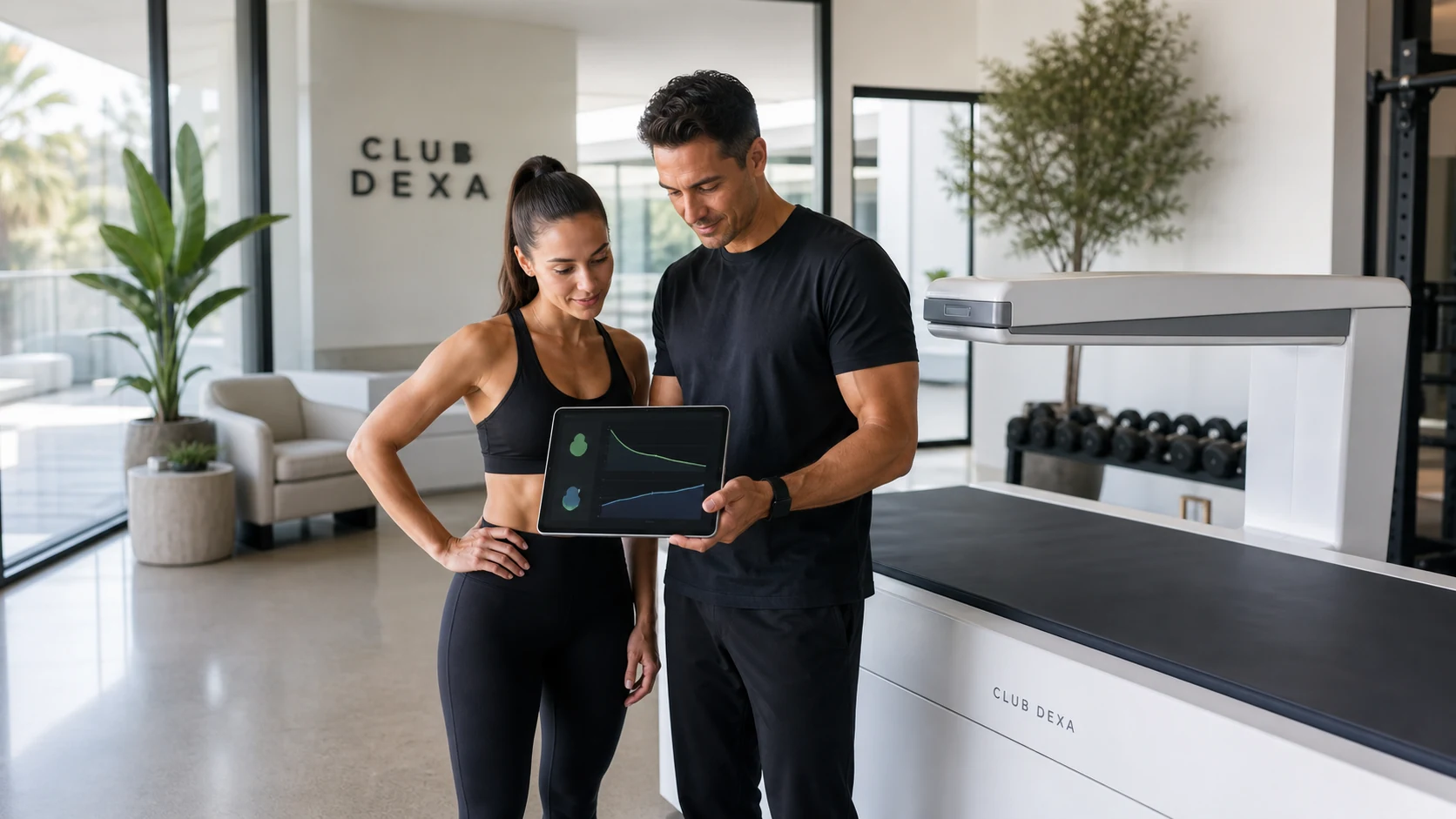
Body recomposition means your body composition is changing even if scale weight is not moving much. The common pattern is fat mass trending down while lean mass is stable or increasing.
That is exactly where a DEXA scan can be useful. The scale can only show total weight. A DEXA body composition scan can estimate fat mass, lean mass, body fat percentage, visceral fat, and regional changes so you can see whether a stalled scale is actually hiding progress.
CLUB DEXA is opening soon in Irvine. Founding Members can lock in $49 standard DEXA body composition scans for life before booking opens, subject to additional terms, with no payment today.
Recomposition scan strategy
- First scan: before or early in a new training and nutrition phase.
- Follow-up: often 8 to 12 weeks later.
- Watch: fat mass, lean mass, body fat percentage, waist trend, strength, photos, and clothing fit.
- Good trend: fat mass down with lean mass stable or up.
- Review the plan if: both fat mass and lean mass are moving the wrong direction.
- Best use: compare trends, not one isolated scan.
Why the scale can look stuck
Scale weight combines fat, lean tissue, water, glycogen, food volume, and normal daily fluctuation. If you lose a few pounds of fat while gaining or retaining lean mass, the total number may barely change.
That can feel frustrating if the scale is your only feedback loop. But for many lifters, active weight-loss clients, and people returning to training, body composition matters more than scale weight alone.
DEXA helps separate the question into parts: did fat mass change, did lean mass change, and did the ratio improve?
What DEXA can show during recomposition
A DEXA body composition scan can estimate:
- Total fat mass
- Total lean mass
- Body fat percentage
- Visceral fat estimates
- Regional lean and fat distribution
- Bone mineral information from the scan
A peer-reviewed review on DXA body composition describes how the scan can estimate body composition measures such as fat mass and lean soft tissue. For fitness tracking, the practical value is not that one scan tells the whole story. The value is the baseline-and-follow-up comparison.
How to read a recomposition trend
A useful recomposition trend usually looks like one of these:
- Weight flat, fat mass down, lean mass stable
- Weight flat, fat mass down, lean mass up
- Weight slightly up, lean mass up more than fat mass
- Weight slightly down, fat mass down while lean mass is mostly preserved
None of these patterns should be judged from DEXA alone. Pair the scan with strength numbers, training consistency, nutrition, sleep, measurements, photos, and how your clothes fit.
If you want a deeper report walkthrough, read how to read your DEXA scan results. If you are comparing testing methods, see the guide to the best way to measure body fat percentage near Irvine.
What to do before you change the plan
Do not cut calories or add training just because the scale paused for a week. First, ask better questions:
- Is fat mass trending down between scans?
- Is lean mass stable or increasing?
- Are strength and training quality improving?
- Are waist, photos, or clothing fit changing?
- Were scan conditions similar enough to compare?
If the answer is yes, the plan may simply need more time. If fat mass is not moving and lean mass is not improving, then it may be time to review calories, protein, training stimulus, recovery, and adherence with the right coach, dietitian, clinician, or care team.
Strength training and protein still matter
Recomposition is not created by the scan. The scan only measures the trend.
For adults, the Physical Activity Guidelines for Americans recommend regular aerobic activity and muscle-strengthening activity at least two days each week. The International Society of Sports Nutrition also notes that resistance exercise and protein intake work together to support muscle protein synthesis, with higher protein needs often applying to exercising people.
That does not mean everyone needs the same training plan or protein target. It does mean recomposition should be interpreted in context: training stimulus, nutrition consistency, recovery, and time all matter.
When to scan again
Most recomposition plans need enough time for a real signal to show up. For many people, an 8 to 12 week follow-up works better than scanning every few weeks.
Shorter intervals can be noisy because hydration, glycogen, soreness, food volume, and positioning can all affect comparisons. Longer intervals can make sense for experienced lifters, slower recomposition plans, or maintenance phases.
For a broader timing guide, read how often you should get a DEXA scan.
Local scan planning near Irvine
If you are starting a recomposition phase in Irvine or Orange County, a baseline scan helps you stop guessing. You can scan before the plan starts, train through a real block, then compare fat mass and lean mass after the plan has had time to work.
For the local scan path, read DEXA Scan in Irvine: $49 Founding Member Scans. If price affects whether you can repeat scans, compare local pricing in DEXA Scan Cost in Orange County.
Quick FAQ
Can DEXA show body recomposition?
DEXA can estimate fat mass and lean mass, which makes it useful for tracking recomposition trends. It does not prove why the change happened.
What if my weight is the same but body fat is lower?
That may be a positive recomposition trend, especially if lean mass is stable or higher and your training, measurements, photos, and performance support the same direction.
How soon should I recheck?
Many people wait 8 to 12 weeks. That gives the plan enough time to create a clearer trend while limiting noise from short-term fluid and glycogen shifts.
Is lean mass the same as muscle?
No. Lean mass includes muscle and other non-fat tissue, and it can be influenced by hydration and glycogen. Treat it as a useful trend marker, not a perfect muscle-only number.
Why does Founding Member pricing matter?
Recomposition tracking works best with a baseline and follow-up. Locking in $49 standard scans makes it easier to use DEXA as a repeat tracking system instead of a one-time curiosity.
Start your recomposition baseline with CLUB DEXA
CLUB DEXA helps Irvine and Orange County clients measure what the scale cannot. If you are starting a recomposition phase, join the Founding Member List before booking opens to lock in $49 standard DEXA body composition scans for life, subject to additional terms.
No payment today. Email confirmation is required to lock the offer. Expected regular pricing after launch starts at $89 per standard scan.
DEXA body composition scans are for fitness and wellness tracking only and are not a substitute for medical advice, diagnosis, or treatment.
Sources and fine print
- Body composition with dual energy X-ray absorptiometry: from basics to new tools
- HHS: Top 10 Things to Know About the Physical Activity Guidelines for Americans
- International Society of Sports Nutrition Position Stand: protein and exercise
- CDC: Facts About Bone Density (DEXA Scan)
Related articles
Should You Drink Water Before a DEXA Scan?
Learn how water intake can affect a DEXA body-composition result and how to keep repeat scans more comparable.
DEXA Scan vs Waist Measurement: What Each Can Tell You
Compare a DEXA body-composition scan with a waist measurement, including what each tracks, why the numbers are not interchangeable, and how to use both in a repeatable progress routine.
DEXA Scan vs Skinfold Calipers: Which Is Better for Body Fat Tracking?
Compare DEXA scans and skinfold calipers for body-fat tracking, including what each method measures, why the results differ, and how to choose a repeatable baseline.


Join as a Founding Member
Lock in $49 DEXA scans for life. Join the Founding Member List before booking opens in Irvine. Your standard body composition scan price will never increase, subject to additional terms. Expected regular pricing after launch starts at $89 per scan.
- $49 scans for life
- Priority launch booking
- No cost to join
No payment today. No spam. Your Founding Member price will never increase. Founding pricing applies to standard CLUB DEXA body composition scans for the registered email/account holder. Founding Member pricing includes up to 6 standard scans per calendar year. Additional scans are subject to regular pricing. Non-transferable. Excludes add-ons, bundles, third-party services, and special clinical services. Subject to appointment availability. Expected regular pricing may change before or after launch. Email verification is required before Founding Member pricing is treated as locked.