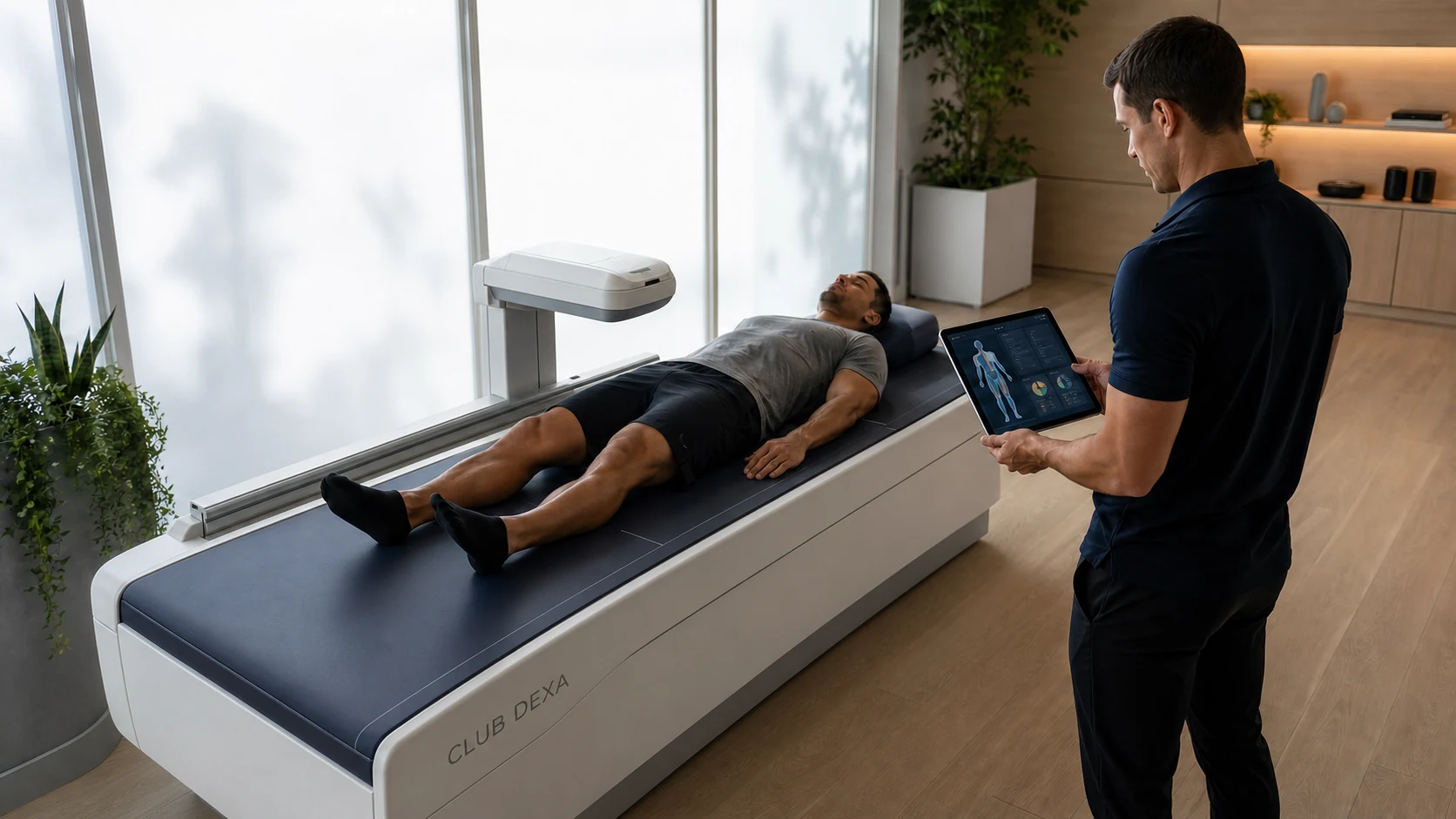
Quick answer
Fat mass index, usually shortened to FMI, compares your total fat mass with your height. It is calculated by dividing fat mass in kilograms by height in meters squared:
FMI = fat mass (kg) / height² (m²)
The unit is kilograms per square meter, the same unit used for BMI. The difference is the numerator: BMI uses total body weight, while FMI uses only the fat mass estimated by a body composition test such as DEXA.
That separation can make FMI helpful when two people have a similar BMI but different amounts of fat and lean tissue. It also gives you another way to follow fat-mass change without confusing it with a change in scale weight. FMI does not replace body fat percentage, regional fat measurements, or the rest of the report; it answers one narrower question about total fat mass relative to height.
The practical interpretation
- FMI uses: total fat mass and height
- BMI uses: total body weight and height
- Body fat percentage uses: fat mass as a share of total measured mass
- Best use: read FMI beside total fat mass, body fat percentage, lean mass, and regional measurements
- For repeat scans: compare the same metric from the same system under similar conditions
If you need the full report first, start with how to read your DEXA scan results.
How is fat mass index calculated?
You need two values:
- Total fat mass in kilograms from the body composition report
- Height in meters
For example, imagine a report shows 18 kilograms of fat mass and the measured height is 1.75 meters:
18 / (1.75 × 1.75) = 5.9 kg/m²
That 5.9 is the FMI. It is not 5.9% body fat, and it should not be read as a body fat percentage.
Some reports calculate FMI automatically. If yours does not, you can calculate it from total fat mass as long as the units and height are correct. You can either convert pounds to kilograms and inches to meters or use the U.S. customary conversion below.
If your report uses pounds and feet/inches
First convert your height to total inches, then use:
FMI = fat mass (lb) × 703 / height² (in²)
For example, imagine a report shows 40 pounds of fat mass and your height is 5 feet 9 inches, or 69 total inches:
(40 × 703) / (69 × 69) = 5.9 kg/m²
The result is still reported in kg/m². The factor 703 handles the pounds-and-inches conversion; it does not turn FMI into a value reported in lb/in².
FMI versus BMI
BMI and FMI both adjust a mass value for height, but they describe different things.
BMI includes everything on the scale
BMI divides total body weight by height squared. That total includes fat mass, lean soft tissue, bone mineral, water, and other components. BMI is simple and widely used, but it cannot show which part of body weight comes from fat or lean tissue.
FMI isolates estimated fat mass
FMI uses the fat-mass result from the body composition measurement. A review of body composition by DEXA describes this height-normalized index as a way to separate fat status from lean mass status.
That distinction can matter for someone who carries more muscle, is changing both fat and lean mass, or wants to understand why scale weight and body composition are telling different stories. It does not make every FMI value self-explanatory; the scan method and the reference used still matter.
FMI versus body fat percentage
FMI and body fat percentage both use fat mass, but the denominator changes.
- FMI: fat mass divided by height squared
- Body fat percentage: fat mass divided by total measured mass, multiplied by 100
Because body fat percentage uses total mass, it can change when either fat mass or lean mass changes. FMI is tied directly to fat mass for a person whose adult height is stable.
Imagine fat mass stays the same while lean mass increases. Body fat percentage can fall because fat is now a smaller share of the new total, while FMI stays about the same. Both results can be correct; they are describing the change from different angles.
For more context on the percentage value, read what a good body fat percentage means on a DEXA scan.
What can FMI add to a DEXA report?
FMI is most useful as one line in a broader body composition story.
It separates fat change from total-weight change
Scale weight may stay flat during body recomposition while fat mass decreases and lean mass increases. FMI can move with the fat-mass side of that change even when BMI barely moves.
It makes height-adjusted comparisons possible
Raw fat-mass values are easier to interpret within one person than across people of different heights. Dividing by height squared creates a height-normalized index that can be compared with an appropriate reference.
It can clarify why BMI changed
If BMI rises, FMI and lean-mass results can help show whether the measured gain came mostly from fat, lean soft tissue, or a mix. If BMI falls, the same set of numbers can help separate fat loss from lean-mass loss.
It does not show where fat is stored
FMI is a total-body index. It does not tell you whether fat is concentrated in the abdomen, hips, or another region. Read it beside regional values such as android and gynoid fat and any separate visceral-fat estimate on the report.
What is a good FMI?
There is not one context-free FMI target that fits every adult and every report.
Published reference studies often separate values by sex and age, and the population and scanner system used to create the reference can affect the comparison. A 2025 adult DXA study built age- and sex-specific curves from more than 10,000 participants. An earlier study developed age- and sex-specific fat-mass reference values specifically for GE DXA systems. Those are useful research resources, but a percentile or study cut point should not be copied onto an unrelated report without checking how it was produced.
A practical reading sequence is:
- Confirm the unit. Make sure the value is FMI in kg/m², not BMI, body fat percentage, or fat mass in kilograms.
- Use the matching reference. Check the report's own age-, sex-, and system-specific reference information when available.
- Read the full composition. Review total fat mass, body fat percentage, lean mass, and regional distribution beside the index.
- Compare with your baseline. Use your own prior scan taken under similar conditions.
- Keep health questions in context. Use an appropriate qualified healthcare professional rather than treating one body composition value as a diagnosis.
How to compare FMI between scans
For an adult whose height is stable, a change in FMI mainly reflects a change in the fat-mass estimate. That makes the comparison straightforward, but only if the scans are reasonably matched.
- Use the same scanner and software when possible. Systems and analysis methods can differ.
- Keep preparation consistent. Match time of day, hydration, recent food, recent training, clothing, and positioning as closely as practical.
- Check total fat mass too. The reported pounds or kilograms show the actual input that moved the index.
- Do not overread tiny changes. Normal measurement and biological variation can be larger than a very small shift.
- Allow enough time for the plan to work. A meaningful fat-loss, maintenance, or recomposition phase is more informative than frequent short-interval rescanning.
The guide to DEXA scan accuracy explains why consistent conditions make repeat scans easier to interpret.
Quick FAQ
Is FMI the same as BMI?
No. Both divide by height squared, but FMI uses fat mass while BMI uses total body weight.
Is FMI the same as body fat percentage?
No. FMI adjusts fat mass for height. Body fat percentage reports fat mass as a share of total measured mass.
Can I calculate FMI myself?
Yes. With metric units, divide fat mass in kilograms by height in meters squared. With U.S. customary units, multiply fat mass in pounds by 703, then divide by height in total inches squared. Either method should produce the same FMI in kg/m² apart from normal rounding.
Can FMI change while my weight stays the same?
Yes. During body recomposition, fat mass can decrease while lean mass increases. Scale weight and BMI may stay similar while FMI falls.
Does FMI show visceral fat?
No. FMI is based on total fat mass. A visceral-fat estimate and regional fat measurements answer different questions.
Can FMI diagnose obesity or another health condition?
No single DEXA value should be used alone to diagnose a medical condition or calculate an individualized health risk. Interpretation depends on the reference, measurement system, and individual context.
Build a clearer fat-mass baseline in Irvine
If scale weight does not explain the change you care about, a DEXA baseline can separate total fat mass, lean mass, and regional distribution. FMI adds a compact height-adjusted view of the fat-mass result, while a well-matched follow-up shows whether the full body composition pattern moved in the intended direction.
Read the local guide to DEXA scans in Irvine and Orange County, then join the Founding Member List before booking opens to lock in $49 standard CLUB DEXA body composition scans for life, subject to additional terms. Expected regular pricing after launch starts at $89 per standard scan. No payment is due today, and email confirmation is required to lock the offer.
Sources and fine print
- Open-access review: Body composition by DXA
- PubMed: Adult DXA body composition trajectories and reference values
- PubMed: GE DXA reference standards for body fat measures
CLUB DEXA provides body composition scans for fitness and wellness tracking. It does not diagnose obesity or other medical conditions, calculate individualized disease risk, or provide medical advice. FMI availability, values, and reference information can depend on the scanner, software, analysis method, and population used for comparison. Discuss symptoms, medications, pregnancy, or health concerns with an appropriate qualified healthcare professional.
Related articles

Should You Drink Water Before a DEXA Scan?
Learn how water intake can affect a DEXA body-composition result and how to keep repeat scans more comparable.
DEXA Scan vs Waist Measurement: What Each Can Tell You
Compare a DEXA body-composition scan with a waist measurement, including what each tracks, why the numbers are not interchangeable, and how to use both in a repeatable progress routine.
DEXA Scan vs Skinfold Calipers: Which Is Better for Body Fat Tracking?
Compare DEXA scans and skinfold calipers for body-fat tracking, including what each method measures, why the results differ, and how to choose a repeatable baseline.




Join as a Founding Member
Lock in $49 DEXA scans for life. Join the Founding Member List before booking opens in Irvine. Your standard body composition scan price will never increase, subject to additional terms. Expected regular pricing after launch starts at $89 per scan.
- $49 scans for life
- Priority launch booking
- No cost to join
No payment today. No spam. Your Founding Member price will never increase. Founding pricing applies to standard CLUB DEXA body composition scans for the registered email/account holder. Founding Member pricing includes up to 6 standard scans per calendar year. Additional scans are subject to regular pricing. Non-transferable. Excludes add-ons, bundles, third-party services, and special clinical services. Subject to appointment availability. Expected regular pricing may change before or after launch. Email verification is required before Founding Member pricing is treated as locked.