Quick answer
Usually, yes: DEXA body composition scans can often be paid for or reimbursed with HSA or FSA funds when they qualify as a medical care expense. IRS Publication 502 includes electronic body scans as medical expenses, and IRS guidance also recognizes certain diagnostic scans as medical care expenses even when a person does not have symptoms or a prior doctor's recommendation.
The important qualifier is documentation. Your HSA or FSA administrator has the final say on what they will accept. A clean itemized receipt may be enough, but some administrators may ask for more detail, especially when the scan is described mainly as wellness, weight loss, fitness, or body composition tracking.
What to know before you book
- HSA/FSA eligible? Usually yes, but administrator rules matter.
- Insurance required? No. HSA/FSA eligibility is separate from insurance coverage.
- Doctor referral required? Often no, but some plans may ask for medical documentation.
- Best receipt description: "DEXA body composition scan."
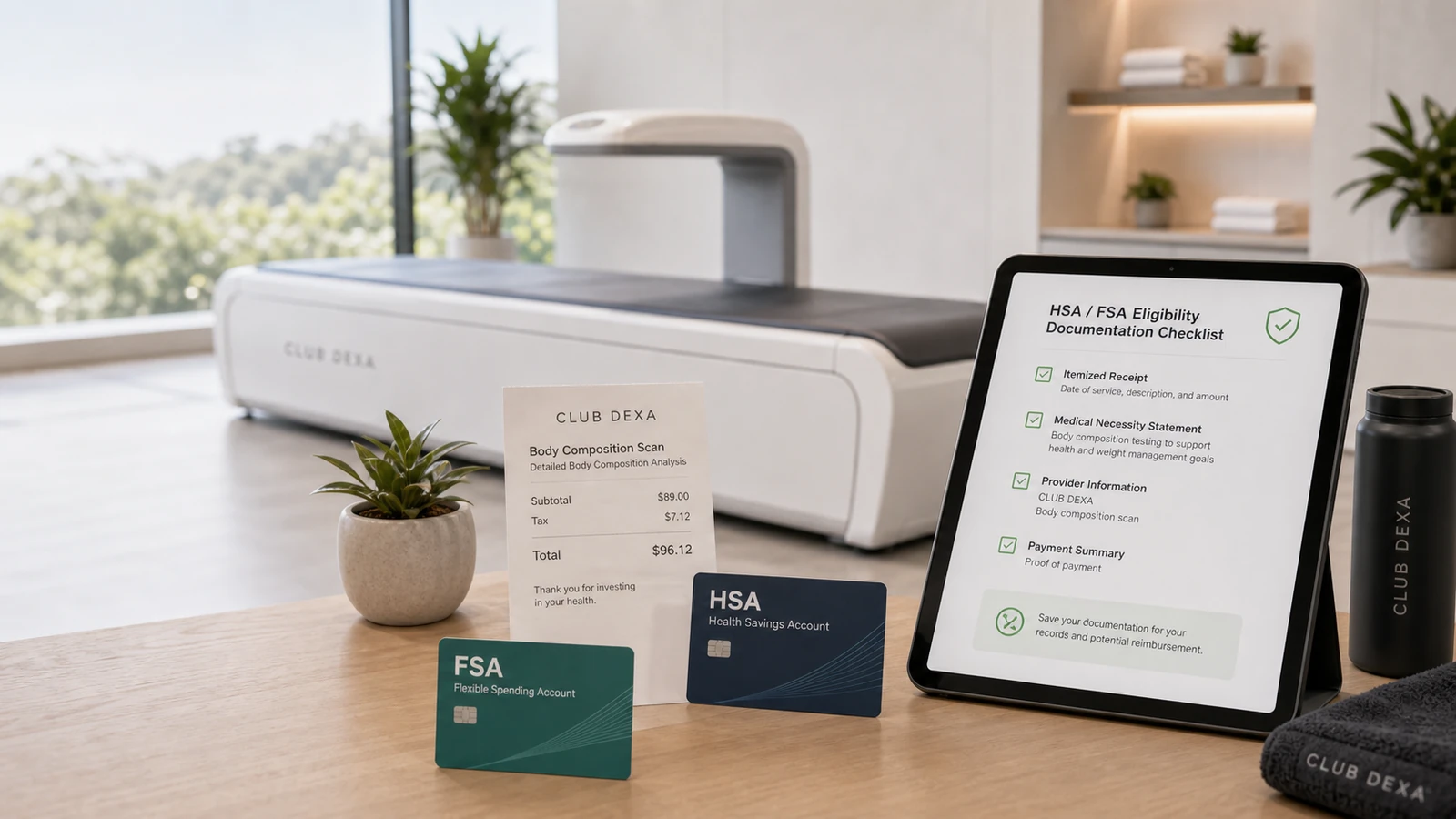
- Keep: provider name, date of service, service description, amount paid, and proof of payment.
- Account type matters: DEXA scans may be eligible through HSA, health care FSA, or HRA accounts, but not dependent care FSAs. Limited-purpose FSAs may also exclude them.
Can I use my HSA or FSA card at checkout?
You may be able to use an HSA or FSA card to pay for a DEXA body composition scan, depending on your card issuer, account administrator, and how the transaction is categorized.
If the card works, still keep your records. Card approval at checkout does not always mean the expense has been fully substantiated. Your HSA or FSA administrator may still ask for an itemized receipt or other documentation later.
If the card does not work, that does not automatically mean the scan is ineligible. You may be able to pay with a regular card and submit the receipt for reimbursement, depending on your plan rules.
Do you need a doctor's note or letter of medical necessity?
Not always. Many DEXA scan claims may be accepted with a clear itemized receipt, especially when the service is listed plainly as a DEXA scan or DEXA body composition scan.
Some administrators may ask for a letter of medical necessity if the scan is framed mainly as weight loss, fitness, performance, or general wellness. A letter of medical necessity is a document from a licensed healthcare provider explaining why the scan is medically necessary for a specific condition, screening purpose, or medical-care goal.
If HSA/FSA eligibility is important to your budget, ask your administrator before booking:
- Is a DEXA body composition scan eligible under my plan?
- Do you need an itemized receipt?
- Do you require a letter of medical necessity?
- Is there specific wording the receipt should include?
Is insurance coverage required?
No. HSA/FSA eligibility and insurance coverage are separate questions.
A DEXA body composition scan may be self-pay and still potentially eligible for HSA or FSA reimbursement. It may also be medically ordered but not covered by insurance, or covered only under specific clinical criteria.
For most body composition scans, the practical question is not "will insurance cover this?" It is "will my HSA or FSA administrator accept this expense, and what documentation do they need?"
If you are comparing out-of-pocket pricing, read the DEXA scan cost guide for Orange County. For local access details, see the guide to DEXA scans in Irvine and Orange County.
What should your receipt say?
For HSA/FSA documentation, specific wording is better than vague wording.
A strong itemized receipt should include:
- Provider name
- Date of service
- Service description
- Amount paid
- Proof of payment
- Any insurance reimbursement or denial, if applicable
For the service description, "DEXA body composition scan" is clearer than "wellness visit," "fitness assessment," or "body scan package."
That wording does not guarantee reimbursement, but it gives your administrator a cleaner record of what the service was.
HSA vs FSA: who checks the paperwork?
With an HSA, you are usually responsible for making sure the expense is qualified and keeping records for tax purposes. Your HSA card may not review every purchase in real time.
With an FSA, the plan administrator usually substantiates claims. That means they may ask for an itemized receipt or other proof showing what the service was, when it happened, who provided it, and how much you paid.
Simple version: HSA users should keep records in case they are asked later. FSA users should expect to submit records.
What counts as a qualified medical expense?
IRS Publication 502 describes medical expenses as costs for the diagnosis, cure, mitigation, treatment, or prevention of disease, and for the purpose of affecting a part or function of the body. It also says medical expenses include equipment, supplies, and diagnostic devices needed for those purposes.
That definition is why diagnostic tests can qualify. IRS guidance has also recognized certain diagnostic procedures, including full-body electronic scans, as medical care expenses even when a person does not have symptoms and did not first obtain a doctor's recommendation.
That said, expenses that are merely beneficial to general health are different. General wellness purchases, gym dues, or services marketed only as lifestyle upgrades can be harder to justify unless there is a medical-care purpose and the right documentation.
Where body composition DEXA fits
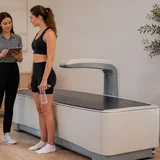
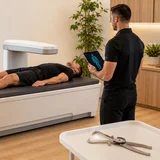
DEXA stands for dual-energy X-ray absorptiometry. The same technology is widely known for bone density testing, and it can also be used for body composition analysis.
Bone density DEXA is usually easier to document because it is commonly ordered for osteoporosis screening or another clinical purpose. Body composition DEXA can still fit the eligibility framework, but the receipt and reason for the scan matter more.
DEXA body composition scans measure fat mass, lean mass, visceral fat, and regional body composition. They are often used by people tracking fat loss, muscle gain, metabolic health goals, GLP-1 weight loss, or long-term wellness. Many eligibility lists treat DEXA scans or body scans as eligible, but your administrator may still review the receipt and the stated purpose of the service.
If you are using DEXA for fitness and wellness tracking, avoid assuming reimbursement is guaranteed. Check your administrator before booking if eligibility matters to your budget.
Which accounts can usually be used?
DEXA scans are commonly listed as eligible for HSA, health care FSA, and HRA reimbursement.
They are not a dependent care FSA expense. Limited-purpose FSAs are usually restricted to dental and vision expenses, so a DEXA body composition scan may not qualify under that type of account.
Can you reimburse yourself later?
With an HSA, you can often pay out of pocket and reimburse yourself later for qualified medical expenses incurred after the HSA was established. You still need to keep proof that the expense was qualified, paid by you, and not already reimbursed elsewhere.
With an FSA, reimbursement timing is tied to the plan year and your employer's plan rules. FSAs usually have stricter deadlines, so do not assume you can wait indefinitely.
What happens if an HSA expense is not qualified?
If HSA funds are used for something that is not a qualified medical expense, the amount may be included in taxable income and may also be subject to an additional tax. IRS Publication 969 explains that nonqualified HSA distributions can be subject to an additional 20% tax unless an exception applies.
That is why it is worth checking before you spend HSA dollars on any service that could be considered wellness, fitness, or performance-focused.
Quick FAQ
Are DEXA body composition scans HSA eligible?
Usually, yes, when the scan qualifies as a medical care expense. Keep an itemized receipt and check your HSA administrator's rules if you are unsure.
Are DEXA body composition scans FSA eligible?
Often, yes, but FSA administrators may ask for substantiation. A clear receipt with "DEXA body composition scan," date of service, provider name, and amount paid is the best starting point.
Do I need insurance coverage?
No. HSA/FSA eligibility is separate from insurance coverage. A self-pay scan may still be eligible for reimbursement.
Do I need a doctor's note?
Not always. Some administrators may accept an itemized receipt, while others may ask for a letter of medical necessity, especially if the scan is framed as weight loss, fitness, or wellness.
What should I keep after the scan?
Keep the itemized receipt, proof of payment, date of service, service description, and any administrator messages about approval or denial.
How to use this for a CLUB DEXA scan
If you plan to use HSA or FSA funds, check your administrator's rules before booking and keep an itemized receipt after your scan. CLUB DEXA can provide an itemized receipt, but your account administrator decides whether the expense qualifies under your plan.
The bigger reason to join early is repeat tracking. One DEXA scan gives you a baseline. Repeat scans help you see whether your plan is changing fat mass, lean mass, visceral fat, and regional body composition over time.
CLUB DEXA Founding Members can lock in $49 standard DEXA body composition scans for life before booking opens, subject to additional terms. Expected regular pricing after launch starts at $89 per standard scan, so the Founding Member price matters most if you want to scan more than once and track real progress instead of guessing.
For more context on what the scan measures, read what a DEXA body composition scan is. If you are deciding how often to scan, see how often you should get a DEXA scan.
CLUB DEXA body composition scans are designed for fitness and wellness tracking. They are not a medical diagnosis and do not replace care from a qualified healthcare professional.
Bottom line
Usually, yes: DEXA body composition scans can often fit the HSA/FSA eligibility framework. The details still matter.
The best move is to check your administrator, keep a clear receipt, and understand that reimbursement eligibility is not the same thing as insurance coverage. If you plan to scan repeatedly, CLUB DEXA's Founding Member offer can also make long-term body composition tracking much more affordable.
This article is educational and is not tax, legal, medical, or insurance advice. Your HSA/FSA administrator or tax professional can give the final answer for your account.
Sources and fine print
- IRS Publication 502: Medical and Dental Expenses
- IRS Publication 969: Health Savings Accounts and Other Tax-Favored Health Plans
- IRS Revenue Ruling 2007-72
Related articles
Should You Drink Water Before a DEXA Scan?
Learn how water intake can affect a DEXA body-composition result and how to keep repeat scans more comparable.
DEXA Scan vs Waist Measurement: What Each Can Tell You
Compare a DEXA body-composition scan with a waist measurement, including what each tracks, why the numbers are not interchangeable, and how to use both in a repeatable progress routine.
DEXA Scan vs Skinfold Calipers: Which Is Better for Body Fat Tracking?
Compare DEXA scans and skinfold calipers for body-fat tracking, including what each method measures, why the results differ, and how to choose a repeatable baseline.


Join as a Founding Member
Lock in $49 DEXA scans for life. Join the Founding Member List before booking opens in Irvine. Your standard body composition scan price will never increase, subject to additional terms. Expected regular pricing after launch starts at $89 per scan.
- $49 scans for life
- Priority launch booking
- No cost to join
No payment today. No spam. Your Founding Member price will never increase. Founding pricing applies to standard CLUB DEXA body composition scans for the registered email/account holder. Founding Member pricing includes up to 6 standard scans per calendar year. Additional scans are subject to regular pricing. Non-transferable. Excludes add-ons, bundles, third-party services, and special clinical services. Subject to appointment availability. Expected regular pricing may change before or after launch. Email verification is required before Founding Member pricing is treated as locked.