Quick answer
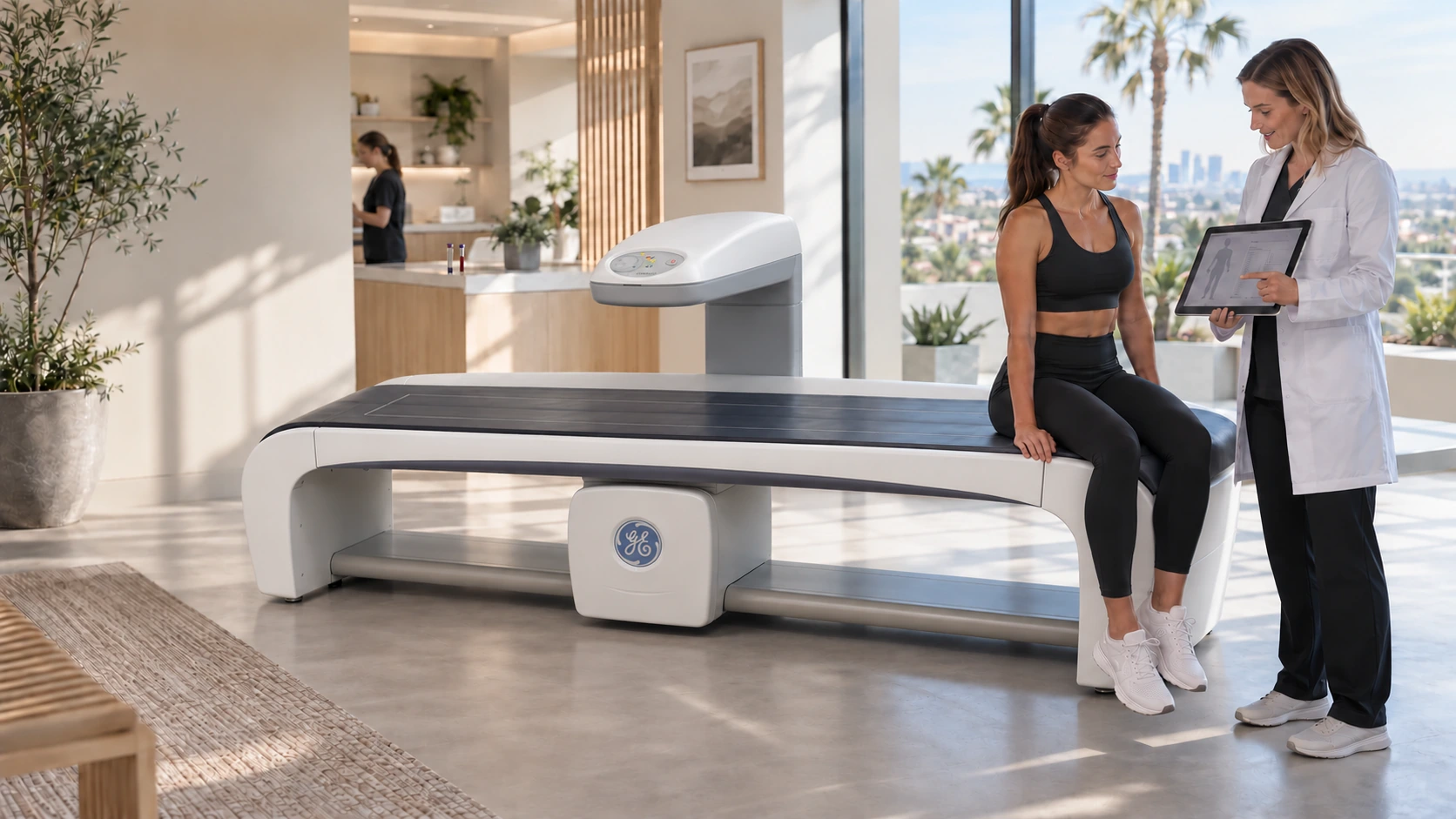
DEXA and blood work answer different questions, so their results should not be expected to match or replace one another. A whole-body DEXA scan estimates broad body-composition compartments such as fat mass, lean soft tissue, and bone mineral content. Blood work analyzes substances in a blood sample, such as glucose, lipids, cells, enzymes, or other markers chosen for a specific clinical question.
If you want a repeatable baseline for a fat-loss, muscle-gain, or body-recomposition phase, DEXA can add useful whole-body context. If a clinician is looking at a health marker, medication effect, symptom, or preventive-screening question, the appropriate lab work belongs in that clinical conversation. A low body-fat estimate does not stand in for a lab result, and a normal lab result does not reveal how much of your body weight is fat mass versus lean soft tissue.
For a body-composition baseline in Irvine or Orange County, start with DEXA Scan in Irvine & Orange County.
Different measurements for different decisions
The cleanest way to compare DEXA with blood work is to start with what each test actually observes.
DEXA estimates body-composition compartments
A whole-body DEXA scan uses two X-ray energy levels and software to estimate broad components of measured mass. The International Society for Clinical Densitometry's 2023 Official Positions state that adult total-body reports should include total mass, total lean mass, total fat mass, percent fat mass, bone mineral content, and bone mineral density.
Those values can help answer practical tracking questions:
- Is estimated fat mass moving in the direction intended during a focused phase?
- Is lean soft tissue relatively stable while scale weight changes?
- Does the next scan fit with training performance, measurements, and the rest of the plan?
- Are broad regional results changing in a way that gives useful context?
DEXA does not directly measure blood glucose, cholesterol, hormones, inflammatory markers, iron status, or organ function. It is a body-composition estimate, not a blood panel or a diagnostic workup. For a plain-English guide to the rest of the report, see How to Read Your DEXA Scan Results.
Blood work analyzes a sample, not whole-body tissue compartments
Laboratory testing evaluates a sample of blood, urine, or other tissue for selected substances and quantities. The NIH's MedlinePlus overview of laboratory tests notes that results can be affected by factors such as pre-test instructions, food and drink, medicines, and the specific test being performed.
That means there is no single thing called "blood work." A clinician may order different tests depending on the reason for the visit. For example, the National Heart, Lung, and Blood Institute's blood-test guide describes panels that can include glucose, electrolytes, kidney-function measures, and lipid values such as LDL, HDL, and triglycerides.
Those are useful biochemical or cellular measurements. They are not alternate names for DEXA fat mass, lean soft tissue, or body-fat percentage. A lipid value in blood and estimated fat mass on a DEXA report may both matter to a person's broader health discussion, but they are measured in different ways and answer different questions.
When DEXA is the useful tool
DEXA is most useful when more detail about body composition would change how you track a fitness or wellness goal. It can be a practical fit when you want to:
- Set a whole-body baseline before a deliberate fat-loss, muscle-gain, or recomposition block.
- Compare a follow-up scan after enough consistent time for a meaningful trend.
- See estimated fat mass and lean soft tissue beside scale weight.
- Add broad regional context to an otherwise simple scale-and-measurements routine.
- Keep a milestone record using the same scanner and reasonably similar preparation.
The key is to use DEXA as a trend tool, not a verdict. Hydration, food timing, recent training, positioning, scanner hardware, and software can affect close comparisons. DEXA Scan Accuracy: What Can Affect Results? explains why consistent conditions make a follow-up more useful.
When blood work is the useful tool
Blood work is useful when a qualified clinician needs information that comes from the blood sample itself. That may include a preventive-screening, medication-monitoring, symptom, or condition-specific question. The right panel, timing, preparation, reference range, and interpretation depend on the exact reason for testing.
That is why a DEXA report should not be used to reassure yourself about a blood marker, and a result outside a laboratory reference range should not be self-interpreted through a body-composition result. A body-composition scan cannot diagnose diabetes, cardiovascular disease, thyroid conditions, anemia, or another medical condition. A lab result also cannot calculate a personal body-fat percentage or show whether a weight change came from fat mass, lean soft tissue, water, or bone mineral content.
If you have symptoms, a new abnormal result, pregnancy, medication questions, or a condition-specific concern, follow the clinician's testing and follow-up plan. CLUB DEXA does not order, interpret, or replace clinical laboratory testing.
A simple way to keep the two data streams useful
You do not need to turn every number into one score. Give each result a clear job.
1. Start with the decision
For a body-composition decision, define what you want to track: estimated fat mass, lean soft tissue, broad regional context, or the comparison between a baseline and a later milestone. For a laboratory decision, ask the ordering clinician what the test was intended to evaluate and whether any preparation or repeat timing is important.
2. Keep the baselines separate
Compare a new DEXA report with a prior DEXA report from a similar setup. Compare laboratory results with prior results from the same type of test and the clinical context in which they were ordered. Avoid treating one number as a conversion factor for the other.
3. Use the trend that changes the next action
A DEXA trend can help you review whether a training, nutrition, or recovery phase is changing estimated body composition as intended. Laboratory trends may guide a clinical discussion. Both may be relevant to the same person, but they do not need to change on the same schedule or in the same direction to be useful.
4. Bring the right information to the right conversation
Bring a DEXA report to a coach, dietitian, or clinician when its body-composition context helps the conversation. Bring laboratory results back to the clinician who ordered them. That preserves the limits of each tool and prevents a fitness scan from being used as medical advice.
Why the numbers can seem to disagree
It is normal for a body-composition report and blood work to feel connected without being directly comparable. A DEXA result reports estimated mass or a percentage of mass. A lab result may report a concentration, count, activity, or other measurement from the sample. Their units, preparation rules, normal variation, and intended interpretations are different.
For example, a stable scale weight can still leave open questions about estimated fat mass and lean soft tissue that a DEXA comparison may help contextualize. At the same time, a DEXA trend cannot tell you what a clinician-ordered blood marker means. The useful move is to avoid declaring a conflict where the tests were never designed to give the same answer.
Quick FAQ
Can a DEXA scan tell me whether my cholesterol or blood glucose is high?
No. A body-composition DEXA scan does not analyze a blood sample or measure cholesterol, glucose, triglycerides, or other laboratory markers. Ask the clinician who ordered the laboratory test how its result applies to you.
Can blood work tell me my body-fat percentage?
Not in the way a whole-body DEXA report estimates fat mass, lean soft tissue, and percent fat mass. A laboratory result can offer important clinical information, but it is not a whole-body body-composition measurement.
Should I use DEXA or blood work for my health?
They are not substitutes. Follow clinical guidance for laboratory testing. Use a DEXA scan when a non-diagnostic body-composition baseline or repeatable fitness trend would be useful for your goal.
Can I use a DEXA result to interpret an abnormal lab result?
No. DEXA can add body-composition context, but it does not explain the cause or clinical significance of a laboratory result. Follow up with the clinician who ordered the test.
Does a normal lab result mean my body composition is where I want it to be?
No. Laboratory results and body composition describe different things. If your goal is to track estimated fat mass, lean soft tissue, and broad regional context over time, a DEXA baseline can provide information a routine blood panel does not.
Build the body-composition baseline you can use in Irvine
If your goal is a clearer view of a training or nutrition phase, a DEXA baseline can put estimated fat mass and lean soft tissue beside your scale trend. Compare DEXA Scan Cost in Orange County, then join the Founding Member List before booking opens to lock in $49 standard CLUB DEXA body composition scans for life, subject to additional terms. Expected regular pricing after launch starts at $89 per standard scan. No payment is due today, and email confirmation is required before Founding Member pricing is treated as locked.
Sources and fine print
- International Society for Clinical Densitometry: 2023 Official Positions
- NIH MedlinePlus: Laboratory Tests
- National Heart, Lung, and Blood Institute: Blood Tests
CLUB DEXA provides body-composition scans for fitness and wellness tracking. It does not order or interpret laboratory tests, diagnose medical conditions, prescribe treatment, or provide medical advice. Body-composition estimates can vary by scanner, software, protocol, and individual testing conditions. Laboratory results need the context of the exact test, preparation, medical history, and ordering clinician. Discuss symptoms, pregnancy, medications, abnormal test results, or individualized health questions with an appropriate qualified healthcare professional.
Related articles

DEXA Scans for Healthy Aging: What to Track
Learn how older adults can use a DEXA body-composition baseline alongside strength, movement, and clinical care.
DEXA Scan and PCOS: What a Body-Composition Baseline Can Tell You
Learn what a DEXA body-composition baseline can track with PCOS, what it cannot diagnose, and how to use repeat scans without reducing your health to one number.

DEXA Scans for Endurance Athletes: What to Track
Learn how runners, cyclists, and triathletes can use DEXA body-composition scans as repeatable checkpoints without confusing a scan with a performance or health diagnosis.



Join as a Founding Member
Lock in $49 DEXA scans for life. Join the Founding Member List before booking opens in Irvine. Your standard body composition scan price will never increase, subject to additional terms. Expected regular pricing after launch starts at $89 per scan.
- $49 scans for life
- Priority launch booking
- No cost to join
No payment today. No spam. Your Founding Member price will never increase. Founding pricing applies to standard CLUB DEXA body composition scans for the registered email/account holder. Founding Member pricing includes up to 6 standard scans per calendar year. Additional scans are subject to regular pricing. Non-transferable. Excludes add-ons, bundles, third-party services, and special clinical services. Subject to appointment availability. Expected regular pricing may change before or after launch. Email verification is required before Founding Member pricing is treated as locked.