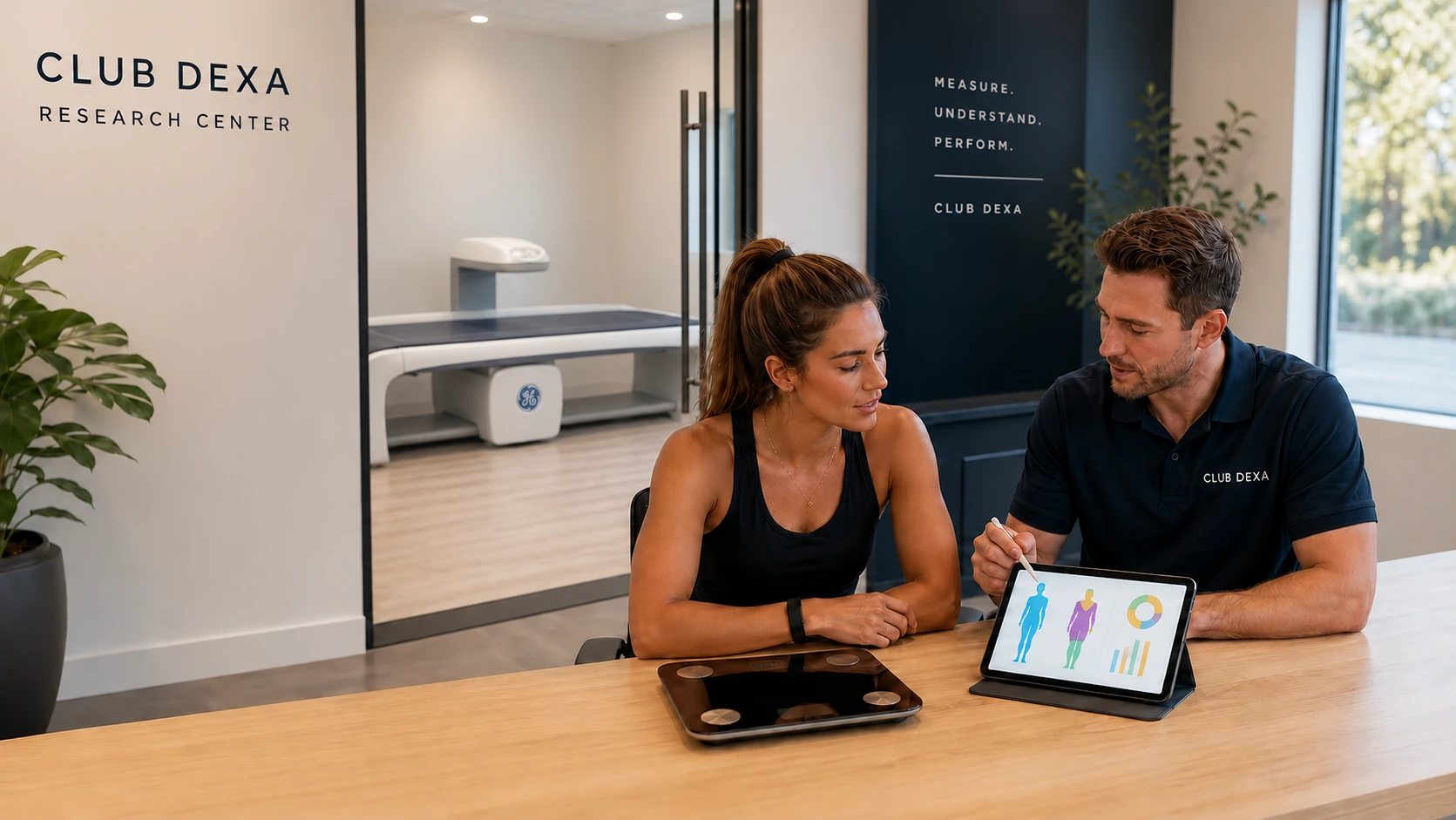
Quick answer
BMI and a DEXA body-fat result can point in different directions because they start with different information. BMI is a calculation from height and body weight. A whole-body DEXA scan estimates fat mass, lean soft tissue, and bone mineral content. Neither number is a diagnosis or a complete description of your health.
BMI can be a convenient screening measure and a simple way to follow body-weight change relative to height. DEXA can add body-composition context when you want to know whether a weight change may be coming from estimated fat mass, lean soft tissue, bone mineral content, or a mix. The useful move is not to force the numbers to agree; it is to understand the question each one can answer.
If you are planning a first body-composition baseline in Irvine or Orange County, start with DEXA Scan in Irvine & Orange County.
What BMI actually measures
BMI is a calculation that divides body weight by height squared. It is quick, inexpensive, and useful for population screening, but it is not a direct measurement of body fat. The CDC explains that BMI cannot distinguish fat mass from lean body mass or bone mass, and it cannot show where body fat is distributed.
That distinction matters for an individual result. Two people can have the same BMI while having different proportions of fat mass, lean soft tissue, and bone mineral content. Someone who has added lean tissue through consistent resistance training may see a higher BMI without that result explaining what changed inside the total body weight. Conversely, a lower BMI does not independently tell you how much of a weight change came from fat versus non-fat tissue.
BMI is still useful when it keeps the question appropriately simple: it tracks weight relative to height. It is not designed to be a personal body-composition report.
What a DEXA body-composition scan estimates
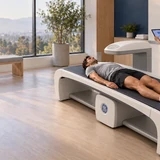
A whole-body DEXA scan uses two X-ray energy levels and software to estimate three broad components: fat mass, lean soft tissue, and bone mineral content. The International Society for Clinical Densitometry's adult positions list total mass, total lean mass, total fat mass, percent fat mass, and bone mineral content among the values that should appear on adult total-body reports.
Depending on the scanner and report, DEXA may also provide broad regional context for the arms, legs, and trunk. That makes it a useful milestone tool for a fat-loss, muscle-gain, or body-recomposition phase. It does not make the report a verdict on fitness, health, nutrition, or a specific muscle group.
Two details keep the report in context:
- Lean soft tissue is not pure muscle. It includes water and other non-fat, non-bone tissue.
- DEXA results are estimates. Preparation, hydration, meal timing, recent training, positioning, scanner hardware, and software can affect close comparisons.
For a report walkthrough, read How to Read Your DEXA Scan Results.
Why BMI and DEXA can disagree
BMI and DEXA do not need to move together because they do not observe the same thing.
- When body weight changes: BMI shows a change in weight relative to height. A DEXA report can add estimated fat-mass and lean-soft-tissue context about that mixture.
- When lean tissue changes: BMI can rise or fall without identifying the tissue. DEXA estimates lean soft tissue, which is still not a muscle-only measurement.
- When fat distribution changes: BMI gives no location information. A DEXA report can provide broad regional context when that feature is included.
- When scale weight stays similar: BMI may barely move. A DEXA comparison can add context for a possible recomposition trend, interpreted with normal measurement variation.
For example, a person can see little change in BMI while a DEXA comparison provides more context about an estimated fat-mass and lean-soft-tissue trend. The reverse is also true: weight loss will change BMI, but BMI alone cannot identify the composition of that loss.
That does not mean one method has exposed a hidden, exact truth while the other is useless. A body-composition review in *Quantitative Imaging in Medicine and Surgery* notes that BMI does not directly measure adiposity, while DEXA-based measures provide additional body-composition information with their own technical limits. The practical lesson is to use the numbers for different jobs rather than subtracting one from the other.
When BMI is the useful tool
BMI is helpful when you need a quick, widely understood screen based on height and weight. It may be a practical data point in a routine health conversation or a simple record of long-term body-weight change.
Use it as one piece of context, especially when you are not trying to answer a detailed body-composition question. If you have a medical concern, unexpected weight change, or a question about health risk, discuss it with a qualified clinician rather than trying to diagnose yourself from a BMI category.
When a DEXA scan adds useful context
A DEXA scan can be the better milestone when the decision needs more than a height-and-weight calculation. It may be useful when you are:
- Starting a focused fat-loss, muscle-gain, or body-recomposition phase
- Comparing a baseline with a follow-up after a sustained, consistent plan
- Looking for estimated fat mass and lean-soft-tissue context beside scale weight
- Reviewing broad regional patterns rather than only total body weight
- Building a repeatable record with the same scanner and similar preparation
The extra detail does not mean that more frequent scans are always more informative. A well-prepared baseline and a thoughtfully timed follow-up are usually easier to interpret than several short-interval scans. When to Recheck a DEXA Scan After Starting a New Plan can help you choose a useful milestone.
A simple way to track without chasing a perfect number
Use the tools in a way you can repeat:
- Keep BMI in its lane. Log height and body weight consistently if a BMI trend is useful to your overall record.
- Create a DEXA baseline when detail would change a decision. Record the date, scan location, and your normal routine around the appointment.
- Make the next scan comparable. Use the same scanner and similar time of day, clothing, hydration, meals, and recent training when practical.
- Review the wider pattern. Look at estimated fat mass, lean soft tissue, scale weight, waist measurements, photos, training performance, and how consistently you followed the plan.
You do not need perfect control for a useful trend. You do need enough consistency that an unusual pre-scan day does not become the entire story. For that routine, see How to Prepare for a DEXA Scan and Should You Drink Water Before a DEXA Scan?.
Quick FAQ
Can a high BMI mean that I have high body fat?
BMI can be associated with body fat at a population level, but it does not separate fat, lean tissue, and bone mass for one individual. A higher BMI alone cannot tell you why body weight is higher.
Can DEXA tell me my exact body-fat percentage?
No. DEXA provides a body-composition estimate based on the scanner, software, and testing conditions. It is most useful for a consistent baseline-and-follow-up comparison, not as an exact or diagnostic label.
Does a normal BMI prove that my body composition is healthy?
No. BMI is one screening measure, not a complete health assessment. A DEXA scan also does not diagnose health conditions. Bring medical questions and individual risk concerns to a qualified clinician.
Should I use BMI or DEXA for fat-loss tracking?
They can work together. BMI is a simple weight-relative-to-height trend. DEXA adds estimated fat-mass and lean-soft-tissue context at larger milestones. Choose the level of detail that will help you make a practical next decision.
What body-fat percentage should I aim for?
There is no single number that fits every person or goal. Use What Is a Good Body Fat Percentage on a DEXA Scan? for a more useful way to interpret the result with your context rather than chasing a universal target.
Build a more useful baseline in Irvine
If you want more context than a height-and-weight calculation can provide, a DEXA scan can be a clear baseline for your next focused phase. Compare DEXA Scan Cost in Orange County, then join the Founding Member List before booking opens to lock in $49 standard CLUB DEXA body composition scans for life, subject to additional terms. Expected regular pricing after launch starts at $89 per standard scan. No payment is due today, and email confirmation is required before Founding Member pricing is treated as locked.
Sources and fine print
- CDC: BMI Frequently Asked Questions
- International Society for Clinical Densitometry: 2023 Official Adult Positions
- NIH/PMC: Body composition with dual-energy X-ray absorptiometry
CLUB DEXA provides body-composition scans for fitness and wellness tracking. It does not diagnose medical conditions, determine treatment, or provide medical or nutrition advice. Body-composition estimates can vary by method, device, software, protocol, and individual factors. Discuss medical questions, pregnancy, unexplained changes, or individualized training and nutrition decisions with an appropriate qualified professional.
Related articles
DEXA Scans for Healthy Aging: What to Track
Learn how older adults can use a DEXA body-composition baseline alongside strength, movement, and clinical care.
DEXA Scan and PCOS: What a Body-Composition Baseline Can Tell You
Learn what a DEXA body-composition baseline can track with PCOS, what it cannot diagnose, and how to use repeat scans without reducing your health to one number.

DEXA Scans for Endurance Athletes: What to Track
Learn how runners, cyclists, and triathletes can use DEXA body-composition scans as repeatable checkpoints without confusing a scan with a performance or health diagnosis.


Join as a Founding Member
Lock in $49 DEXA scans for life. Join the Founding Member List before booking opens in Irvine. Your standard body composition scan price will never increase, subject to additional terms. Expected regular pricing after launch starts at $89 per scan.
- $49 scans for life
- Priority launch booking
- No cost to join
No payment today. No spam. Your Founding Member price will never increase. Founding pricing applies to standard CLUB DEXA body composition scans for the registered email/account holder. Founding Member pricing includes up to 6 standard scans per calendar year. Additional scans are subject to regular pricing. Non-transferable. Excludes add-ons, bundles, third-party services, and special clinical services. Subject to appointment availability. Expected regular pricing may change before or after launch. Email verification is required before Founding Member pricing is treated as locked.