Quick answer
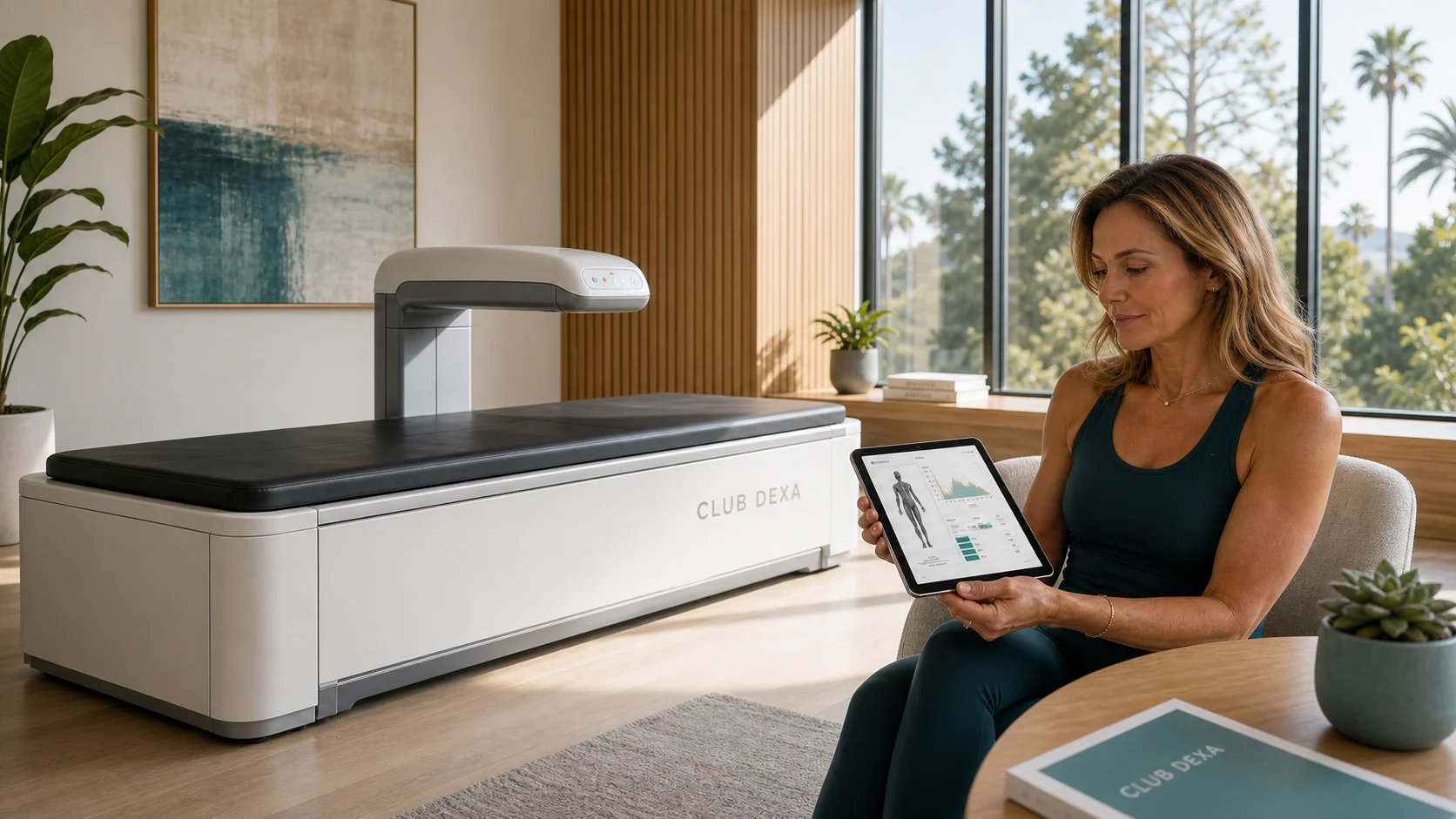
A DEXA body composition scan can be useful during menopause because it separates scale weight into more meaningful pieces: fat mass, lean mass, body fat percentage, and regional body composition. That makes it easier to see whether a training, nutrition, or lifestyle phase is changing the tissue you actually care about.
The most useful pattern is simple: get a baseline before a major change, recheck after roughly 8 to 12 weeks, then compare fat mass, lean mass, trunk or android-region data when available, waist measurement, strength, sleep, and recovery notes together.
For many people in perimenopause, menopause, or early postmenopause, the scale can feel confusing because weight may stay flat while body composition shifts. DEXA helps turn that vague feeling into a trackable baseline.
What to know before you scan
- Compare fat mass and lean mass, not body fat percentage alone.
- Watch regional changes, especially trunk or android-region data when your report includes it.
- Pair scan results with waist measurement, strength numbers, sleep, and recovery notes.
- Use the baseline as a starting line, not a pass/fail score.
- Recheck during active changes after enough time for a trend to show up.
- Scan under similar conditions so follow-up comparisons are cleaner.
Why menopause changes the tracking question
During midlife, the question is often not just, "Did my weight change?" A better question is, "What changed?"
Two people can gain the same amount of weight and have very different changes in fat mass, lean mass, and waist measurement. Someone else may maintain scale weight while losing lean mass and gaining fat mass. That is why body composition tracking can be more useful than weight alone.
Research on the menopause transition has linked this period with changes in body composition and weight. In the Study of Women's Health Across the Nation, researchers reported changes in fat mass and lean mass across the menopause transition. Other research has looked specifically at lean and muscle mass changes in middle-aged women, with physical activity appearing helpful for maintaining skeletal muscle mass.
The practical takeaway is simple: if your body is changing, use measurements that can show what is changing.
What DEXA can track
A DEXA body composition scan can estimate:
- Total body fat percentage
- Fat mass
- Lean mass
- Regional body composition
- Appendicular lean mass or limb lean mass, depending on the report
- Trunk or android-region data, depending on the scanner and software
That can help you compare a baseline scan with a follow-up scan after a training, nutrition, or lifestyle phase.
For a broader overview, read what a DEXA body composition scan measures. If visceral fat or waist change is your main concern, the guide to DEXA scans for visceral fat gives more context.
What to compare between scans
The most valuable comparison is not one number. It is the pattern across several numbers:
- Fat mass: is the amount of fat tissue moving in the intended direction?
- Lean mass: are you preserving or building lean tissue during the phase?
- Body fat percentage: is the ratio changing because of fat loss, lean mass gain, or both?
- Trunk or android-region data: is central body composition changing over time?
- Waist measurement: does the simple tape measure agree with the scan trend?
- Training performance: are strength, energy, and recovery supporting the body composition goal?
This is where DEXA can be especially useful during midlife. It gives you a more detailed scoreboard, while your training log and lifestyle notes explain the context around the score.
Fat mass, lean mass, and the scale
The scale is useful, but it is blunt. It cannot tell you whether a 5-pound change came from fat, lean mass, water, or a mix of changes.
During menopause and midlife, that distinction can matter. If your goal is fat loss, you probably want fat mass trending down while lean mass is protected. If your goal is strength, recomposition, or long-term health, you may care more about preserving or building lean mass than chasing a lower body weight.
For the muscle-focused side of the question, read DEXA scans for muscle gain and lean mass.
When to get a baseline and recheck
If you are in perimenopause, menopause, or early postmenopause and changing your training or nutrition, a baseline scan can be useful before the biggest changes happen.
A common follow-up window is about 8 to 12 weeks during an active phase. That is usually long enough for a meaningful trend to show up without turning measurement into a weekly distraction.
If you are maintaining, training steadily, or simply watching long-term trends, a less frequent rhythm may be enough. For a broader timing guide, read when to recheck a DEXA scan after starting a new plan.
How to make the scan more useful
To make your baseline and follow-up easier to compare:
- Scan under similar conditions when possible.
- Keep training and nutrition notes.
- Track waist measurement between scans.
- Watch strength, energy, sleep, and recovery trends.
- Avoid overreacting to one isolated number.
The scan is most useful when it becomes part of a decision system, not the only measurement you trust.
Quick FAQ
Can a DEXA scan tell if menopause caused weight gain?
No. DEXA can show body composition at the time of the scan and changes between scans. It cannot prove why a change happened.
Is a DEXA body composition scan the same as a bone density test?
No. Body composition DEXA and medical bone density DEXA are different scan contexts. For the difference, read body composition DEXA vs bone density DEXA.
Should I track lean mass during menopause?
It can be useful, especially if you are strength training, losing weight, or trying to preserve muscle. Lean mass trends can add context that scale weight misses.
How often should I scan?
During an active body composition phase, many people use an 8 to 12 week follow-up window. Maintenance phases may need less frequent testing.
CLUB DEXA approach
CLUB DEXA gives Irvine and Orange County clients a premium place to measure body composition trends, including fat mass, lean mass, body fat percentage, and available regional metrics.
Join the Founding Member List before booking opens to lock in $49 standard DEXA body composition scans for life, subject to additional terms. No payment today.
Where DEXA stops
DEXA is a measurement tool. It can show body composition at one point in time and changes between scans, but it cannot tell you:
- Whether menopause is causing a specific symptom
- Whether hormone therapy is appropriate
- Whether a medical condition is present
- What medication, supplement, or diet you should use
- Whether your bone density needs medical treatment from a body composition scan alone
At CLUB DEXA, body composition scans are used for fitness and wellness tracking. Medical care, hormone therapy, symptom management, diagnosis, cardiovascular risk, and bone health treatment decisions belong with qualified healthcare professionals.
Sources and fine print
- Changes in body composition and weight during the menopause transition
- Role of Menopausal Transition and Physical Activity in Loss of Lean and Muscle Mass
- Weight, Shape, and Body Composition Changes at Menopause
- Body composition by DXA
This article is educational and is not medical advice. CLUB DEXA does not diagnose menopause-related symptoms, prescribe treatment, manage hormone therapy, or replace care from a qualified healthcare professional.
Related articles
Should You Drink Water Before a DEXA Scan?
Learn how water intake can affect a DEXA body-composition result and how to keep repeat scans more comparable.
DEXA Scan vs Waist Measurement: What Each Can Tell You
Compare a DEXA body-composition scan with a waist measurement, including what each tracks, why the numbers are not interchangeable, and how to use both in a repeatable progress routine.
DEXA Scan vs Skinfold Calipers: Which Is Better for Body Fat Tracking?
Compare DEXA scans and skinfold calipers for body-fat tracking, including what each method measures, why the results differ, and how to choose a repeatable baseline.


Join as a Founding Member
Lock in $49 DEXA scans for life. Join the Founding Member List before booking opens in Irvine. Your standard body composition scan price will never increase, subject to additional terms. Expected regular pricing after launch starts at $89 per scan.
- $49 scans for life
- Priority launch booking
- No cost to join
No payment today. No spam. Your Founding Member price will never increase. Founding pricing applies to standard CLUB DEXA body composition scans for the registered email/account holder. Founding Member pricing includes up to 6 standard scans per calendar year. Additional scans are subject to regular pricing. Non-transferable. Excludes add-ons, bundles, third-party services, and special clinical services. Subject to appointment availability. Expected regular pricing may change before or after launch. Email verification is required before Founding Member pricing is treated as locked.